Archives

update drive letter access nero Buysofts ¨C Software Downloads at Best Rates bag of gold coin for nero download guitar pro tab ACDSee Photo Editor 2008 guitar pro 4 update patch nero micro v6.14 ACDSee Photo Manager 2009 nero burning forums nero 6.6.0.6 keygen orion Nero 8 Ultra Edition kvcd to dvd nero free nero cd burner download Ahead Nero 9 Reloaded windows xp nero nero media player plug ins Guitar Pro 5 MAC nero dj scratch box nero 8 ultimate edition update CodeGear RAD Studio 2009 Architect bootable cd nero 5

Recent Headlines

  • Pedicab quandary in St. Paul: Basically, pedicabs aren’t regulated in St. Paul, and there’s a question of if adding regulation would protect operators. It probably would, if St. Paul were capable of sensible regulation – something that can be debated.

    There are some classic St. Paul-isms in this article that point to that very concept:

    The woman and seven officers convened on the scene, where they talked for two hours before reaching a decision to ticket him.

    Uh, two hours? Awesome.

  • Edina Bike Trail Controversy: Edina want to build a bike trail via the Nine Mile Creek watershed/wetland. A bunch of neighbors are opposed. Those opposed to the opposed neighbors are making it out to be NIMBYism. The opposed claim it’s about suitability because of the wetland nature of much of the route. Various groups are building websites and Facebook groups around their positions.

    I’m not familiar with the entire run of the trail, but I suspect a middle ground is pretty accurate. The public land is pretty narrow and tends to mud, high water during spring thaw that creates trail erosion and maintenance issues and, of course, skeeters. (It’s a creek!)

    There are a couple of quotes around facilities issues in the Strib piece that stick out:

    “Just like you don’t put a playground in a parking lot, I wouldn’t put a bike trail on a roadway unless there is completely no other way.”

    That’s because when you build it on-street, it’s definitionally not a trail. Depending on construction protocol, there are lots of terms for on-street bikeways. Bicycle facilities encompass a lot more than happy little trails.

    For me, it also comes down to a question of purpose. It appears the approach is as a recreational trail. A roadway route has greater merit in connecting bicycles to destinations and driving greater multi-mode adoption. Many end-to-end recreational trails, particularly smaller ones in neighborhoods, don’t actually have a lot of community impact on mode shift. As such, I’d rather see them working on on-street facilities that help connect users to community destinations, rather than happy views of the creek.

  • Legal Roadblocks to Greenway Extension: A judge has ruled in favor of the Canadian Pacific in a right-of-way dispute over the Ayd Mill railway corridor, a target for those who wish to extend the Midtown Greenway to downtown St. Paul. There is a meeting about ongoing vision and next steps for Greenway extension planning on July 28.

Cedar Lake Trail in Final Phase

Cedar Lake Trail ConnectionThere’s been a bunch of coverage of the final phase of the Cedar Lake Trail. After years of right-of-way issues, the construction of Target Field, and funding, the final easement to extend the trail to the river has been acquired.

The timing for this is interesting – because of the many issues with right-of-way, as well as building a mile of trail through the densest part of the urban core, this is going to be monstrously expensive. Estimates for the total cost of this last segment exceed $9.2 million dollars, paid via a combination of state funds, federal earmark, donations and even funds from the city of Minneapolis.

A lot of people question this expense, particularly at a time of challenging federal, state and municipal budgets.

One thing to keep in mind is that this won’t ever become any cheaper, short of a zombie apocalypse that devastates that piece of Minneapolis and makes the construction easier. Costs to get the construction going are cheaper now than at any time in the recent past, due to high labor supply.

The maze to get from the de facto current trailhead to the river frustrates many. Some of the city’s recent shenanigans with parking, bike lanes, taking streets two-way from one-way, and etc. haven’t helped. Obviously, this of itself doesn’t justify expense – but the completion has been planned for many years.

Completion is scheduled for November. I am assuming that the extension, like the rest of the trail, will be plowed during the winter, adding to the Minneapolis commuter trail network that is quite workable even in the nastiest months of the year. However, it’s always good to confirm plowing each year – budgets being what they are.

Thursday Night Lights: Why Are you Not There?

Obviously, I realize that the National Sports Center is in Blaine, which for many is like coming up to a strange, far away planet. But the Thursday Night Racing series at the Velodrome is one of the most accessible, fun opportunities to check out bicycle racing in the Twin Cities.

Unlike some of the road races, you get to sit in stands, and you’ll see a LOT of racing. You’ll get to see some interesting race disciplines and get to watch the entirety of the tactical execution. Oh, and there are prize drawings too.

Recently, the Trinidad and Tobago National Cycling Team has been racing on Thursdays, and are resident at the Velo as a training camp. Other racers on the track are also international quality.

It starts every Thursday at 7. It’s free, although they appreciate donations.

Sharing the Road: Bicycles & Autos & Turn Signals, Oh My.

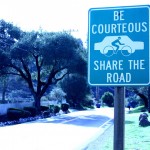
It seems like one of today’s big trend stories is about how motorists can better share the roads with bicyclists. Everyone from Bicycling magazine to local papers are getting in the act.

Never one to let a trend completely pass me by unless it’s a really heinous one (I’ve never owned a pair of Crocs, for instance), I think this is all very well and nice. They are all chock full of helpful advice for motorists and cyclists, such as the 3-foot passing rule, wearing helmets, avoidance of distracted driving, etc. etc.

But you know what? I have not seen a single article mention something I think is fundamental: Cars need to signal their turns. Use your turn signals, motorists.

A number of the articles mention the danger of the right-hook – where a cyclist on the curb lane ends up to the right of a vehicle who is right turning, with somewhat predictably painful results. There are several good ways to avoid the right hook, but one of the top ways – beyond cyclists wising up to the idea that hugging the curb isn’t always strictly necessary under law, and is often injurious – is for vehicles who are right turning to always signal their intent.

Because this doesn’t always happen, I tend to be mildly annoying in lanes that can work as either right-turn or through lanes, pulling to the left into the right-hand wheel well where vehicles might go, even if there’s not a car at the intersection when I arrive there. A vehicle arriving might pull alongside, and depending on positioning, it an be difficult to see a signal if it’s even used.

Turn signals are really bueno for the benefit of other cars and pedestrians on the road, too.

So, in summary: Sure, read all those happy articles about road sharing. Then try using your turn signals. Cyclists, pedestrians and other motorists will praise you for it.

On the Death of the Carpool to School

One of the key issues in a number of cycling initiatives – Complete Streets, Safe Routes to Schools, etc. – is the concept that fewer kids are bicycling or walking within the community than in days of yore. This is, of course, provably and statistically true.

With a lot of the lines of vehicles waiting outside schools to pick up individual children, there’s a secondary question about the death of carpools. Now, I can see where the existing infrastructure in some places is a huge barrier in having people walk or ride their bicycles to school. For instance, in Anoka County, if your kid were to have to cross MN65, it’s pretty close to a non-starter, even with chaperoning adults. Statistics say that the corridor is just an accident hotbed. However, much as when I was a kid we all walked to school, when the weather was awful, our parents didn’t take us one to a vehicle. The neighbors would coordinate, and we’d pile kids into one or two cars total. At school pickup, if the next-door neighbor leaned out the door and said that she was picking me up too and had talked to my mom, this was also highly credible. (It’s not as though I was taking a ride from a stranger – this was the next-door-neighbor, also picking up her own kids with whom I played every afternoon!)

This doesn’t happen any more. And I think I realized why the other day: Booster seat laws. I don’t see this mentioned anywhere lamenting all the minivans lined up outside schools, but on consideration, it’s absolutely a factor.

Think about it: Kids are supposed to ride in boosters until they are 48″ tall. That’s 4 feet. Many states make this a law. If you start looking at growth charts, most kids will be in boosters for most of elementary school. Parents typically have the proper seating for their own kids, and not to pile all their kids’ friends into the minivan to go to soccer or the pool or school.

There are ergonomic and design reasons for booster seat requirements. However, when you consider the death of the carpool, it raises a question if there is a role for finding a way to create more flexible built-in restraint systems in family vehicles (minivans, SUVs, wagons) that meet established safety standards but allow for loading up a spare kid without use of a booster. Because even with safer routes and infrastructure, this is the midwest, and you won’t always avoid the day where it’s raining sideways and there’s a tornado warning and flash flood watch. Not the nature of things. And on such days, there may always be a role for a parent to pick up a carful of kids, rather than have them use even nice safe streets to get home looking like drowned kittens.

Cycling Classes for Women


Women and girls have traditionally been underrepresented among cyclists – recreationally and as bicycle commuters. There are a lot of reasons for this, including the traditional role of female as caregiver. Trailers aside, heavy use of a bicycle is a lot harder when trips include stops to daycare, work, and the grocery store. Surveys have also suggested that women feel more nervous cycling on roadways than men do.

Bike Walk Twin Cities, which is a federally-funded initiative through the Non-Motorized Transportation Pilot Program, is working within the community to reach out to underrepresented groups such as women, and in the coming weeks have a number of pretty awesome educational opportunities for women. There are several Biking with Traffic class opportunities for women, each 1.5 hours long and taught by women who are League of American Bicyclists Certified Instructors.