Ride Boldly!

Bikes, bicycling, and road safety.

February 23, 2011
by julie
Comments Off on Last Call: Minnesota Bicycle Summit

Last Call: Minnesota Bicycle Summit

0saves

Minnesota Bicycle SummitThe Minnesota Bicycle Summit is next Monday, February 28. The legislative priorities have been posted.

If you haven’t registered yet, go and do so. While on-site registration is available, let’s be realistic. It’s a lot easier on everyone involved — you, the Bicycle Alliance, the caterers — to have SOME advance notice of your presence. So go and register now, and be there on Monday to hear from James L. Oberstar, Minneapolis Mayor R.T. Rybak, Rochester Mayor Ardell Brede and a posse of others, and then go to advocate for bicycling with your legislators.

Wear something nice for the whole “meeting of legislators,” and see you there!

February 23, 2011
by julie
Comments Off on Funding Transportation: TIGER Program Cuts

Funding Transportation: TIGER Program Cuts

0saves

As the US House debates how to cut spending, one thing is clear: The goal is to cut, and not to make rational decisions.

As a case in point, the House voted to eliminate TIGER, a program that awarded $2 billion in grants to innovative state and local programs last year. TIGER stands for “Transportation Investment Generating Economic Recovery,” and was intended to promote innovative, multi-modal and multi-jurisdictional transportation projects evaluated on environmental and economic benefit. This is a different model than has been used for transportation funding in general. Most transportation dollars are awarded based on arbitrary formulas, and siloed projects that look at single investments — roads, highway, bicycle, transit, etc. TIGER provided a model that encouraged targeted investment evaluated on a project’s ability to improve quality of life and reduce time in traffic.

With limited funds and a crumbling national infrastructure, it makes sense to ask how we can rethink our system, rather than just repaving what’s there without improvements, or asking if there are ways to improve the infrastructure using similar funding. It’s already clear that there are major issues spending the kind of money needed to maintain existing infrastructure, so it makes sense to use the money more intelligently and in ways that provide future opportunity. However, maintaining a program like TIGER would require non-partisan action and vision that may be lacking.

February 23, 2011
by julie
Comments Off on Alabama: Op-Ed on Cyclist Safety

Alabama: Op-Ed on Cyclist Safety

0saves

One legislative priority for the Bicycle Alliance of Minnesota this year is to increase penalties for injury accidents against cyclists and pedestrians. Proposed laws in Minnesota step up existing penalties.

On the plus side, Minnesota often will charge people under existing rules. Not as much in Alabama, where police officers cannot issue citations if they do not see what occurred, even if drivers are clearly negligent. In this op-ed from the Huntsville Times, Morgan Andriulli speaks out about this flaw, and how it makes the excuse “I didn’t see the cyclist” a free pass for negligent behavior.

I especially like this passage:

This is not a debate about who does or does not have the right to be on the road. Our streets and roads are a public-use facility and it is a privilege to use them that comes with responsibilities, drivers and cyclists alike. This is about protecting vulnerable users from others who have failed in their responsibility to not hit things or kill people. Your driver’s license charges you with that responsibility.

Many traffic calming strategies are aimed at protecting vulnerable users, and are frequently opposed on the basis that they “slow down” motorists. It’s important to remember that roads are public-use, and their use is a privilege. There is not necessarily a “right” to certain speeds or exclusivity.

February 22, 2011
by julie
4 Comments
Biking With Babies

0saves

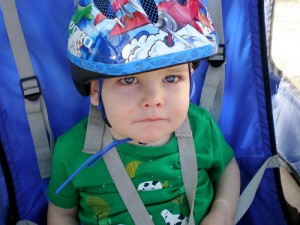
child in bicycle trailerIf you read the literature that comes with the average bicycle baby trailer, your reaction to actually hooking it up may be one of panic. Industry standard recommendation is not to even put the kid into a trailer until at least 12 months.

Personally, I find this a little ridiculous. By 12 months, many children are pulling themselves to standing positions or even walking. While there are certainly developmental concerns to be heeded before putting a kiddo in a trailer, that level of advancement is not necessary. At the same time, the people who rig up strange accommodations involving their carseats and the trailer are probably jumping the gun, and creating unstable riding situations.

With my first child, he didn’t land in the trailer for cycling purposes until about 10 months — he was born in the spring, so that first summer was not going to happen, regardless. My second child is a winter baby, and depending on her development, she may get into the trailer in time for fall 2011 — or wait until spring 2012, when she’ll be closer to 18 months.

My doctor says the 1-year recommendation is probably lawyer-driven, and based on a conservative expectation of infant development. Here are some physical signs that a child may be ready for a trailer ride:

  • Able to sit up under his/her own power
  • Good neck strength
  • Ability to find a helmet that fits/trailer harness that is secure

Neck strength is probably the biggest factor, as the bike helmet adds some weight/awkwardness that neck strength is needed to deal with. The soft spots (fontanelles) on a baby’s skull are also a potential factor — but 12 months isn’t a particularly solid guideline around the soft spot, as they typically begin to close at 6 months but won’t completely grow together until sometime between the 9th and 18th month.

My recommendation is to speak to a medical professional about your child’s physical readiness for a trailer experience. Keep in mind that even with a nice child trailer, the ride in a child trailer is not especially smooth, even on the nicest trail. Every bump will be felt. When you feel comfortable putting the child in the trailer, try to choose smooth routes that will minimize the jostling of the trailer. It helps to have a doctor who is supportive of cycling, and whose response won’t be to freak out about the general safety of cycling.

Additional tips I offer based on personal experience:

  • Build in fun stops, especially as the kiddo gets mobile. Parks are always a good choice.
  • Carry snacks.
  • Ride with a friend. Even if you have someone to call if you have a major mechanical or the like, it’s good to have a buddy with in case of an emergency where you can’t call or someone needs to hang on to the kiddo.
  • Wear your damn helmet. It is not okay to make sure your kid has one and you do not. Being the adult means being a good example.
  • Be sure your bike is in good condition. Tune-ups matter.
  • Don’t try too long a ride the first few times out, between the kid getting used to stuff, and you getting used to the turning radius and weight.

Once we started with Child #1 in trailer, we found he liked to nap in the trailer, and sometimes sing. In nice weather these days, at nearly 3, he’s been known to march up to either me or his father holding his bicycle helmet to demand a ride in the trailer, and he also loves outings to the Thursday Night Races at the NSC Velodrome. We’re hoping to achieve similar result with his little sister, when she’s able to get on board — probably in early fall 2011.

February 21, 2011
by julie
Comments Off on House Transportation Committee Road Show

House Transportation Committee Road Show

0saves

The new House Transportation Committee are doing a series of public meetings in the districts of certain of the committee members. (No meetings are scheduled in Minnesota at this time, despite the committee presence of Chip Cravaak and Tim Walz.)

Reports from early sessions of this dog-and-pony show are disheartening at best. Urban Indy managed to claw its way into the Indianapolis-area meeting and put together a great report of the session.

Of particular interest to cyclists is the following passage from Urban Indy’s report:

The conversation even turned pretty dark with Todd Rokita (R-IN) stating that he thought bike and pedestrian projects should not be funded by federal tax dollars. Another panelist said that the hunters & fisherman faced a similar situation in the past and banded together and determined a licensing program to fund projects and hedged the idea that perhaps cyclists should be using this as a means to fund bicycle projects. The low blow of his testimony was that he started his suggestion by stating that he likes cycling as a hobby and his body language suggested he has no interest in funding cycling infrastructure as well. I wasn’t found of his suggestion that cyclists should be segregated like hunters & fisherman. All of the panelists called DOT “the highway department” which as we all know, DOT are multimodal…. or SHOULD be. But I digress.

Note that Representative Rokita is not a member of the House Transportation & Infrastructure Committee, but that it is not uncommon for local representatives to show up at such hearings when they occur in or near their districts.

Suggesting that cyclists are similar to hunters and fishermen is a dreadful step in the wrong direction. The heart of such an analogy is to suggest that cycling is recreational, and not a legitimate mode of transportation that should be accounted for in broader projects.

Cyclists, pedestrians and users of transit need to speak out and make their voices heard for spending on infrastructure that supports modal choice. Creating infrastructure that supports multiple modes of transportation provides access for economic and social mobility — and supports a cleaner environment and lower oil dependencies. This is going to be a long, hard and repetitive campaign in the current budget climate both in-state and federally, so every voice that can be added is essential!