As Congress discusses making significant budget cuts, cycling and programs that encourage multi-modal transportation options are almost sure to be under threat.
As such, it is highly recommended that cyclists and friends write to their US representative (find yours here) to discourage cutting funding for key programs. A few programs likely to be threatened include:
Section 402 funding – funds support State and community programs to reduce deaths and injuries on the highways.
Safe Routes to Schools – funds enable communities to improve safety and access to permit more children, including children with disabilities, to safely walk and bicycle to school. Children who walk and bicycle to school are less likely to be obese, among other benefits.
Transportation Enhancement Grants – funds help expand transportation choices and enhance the transportation experience, including enhancing pedestrian and bicycle infrastructure and safety programs.
The best bet for contacting your Representative is to use their website e-mail form, or call their office using their published number. Postal mail has numerous issues in the current security atmosphere at the Capitol. The links above provide information about the programs that can help you speak to the value of these investments in alternate transportation options.
January 27, 2011
by julie Comments Off on Richfield Seeks Cyclist Input
The City of Richfield has been hard at work on a Bicycle Master Plan for the community, and are now seeking public input at an upcoming meeting.
The meeting, on February 9, will be from 6:30-7:30 PM at the Richfield Senior High. They’re looking for input on routes, safety, education and more, and even have door prizes to encourage attendance. Representatives from the Bicycle Task Force and community Safe Routes to Schools group will also be in attendance to listen.
Richfield also have a Mobility Survey online. This serves as another means to provide input on their process.
Richfield is striving to be bicycle-friendly. Let’s help ’em out.
January 26, 2011
by julie Comments Off on Bike Path Hijinks Begin in New Congress
The DC Streetsblog reports news from the Senate Environment and Public Works Committee that shows the uphill battle for cycling that’s ahead in the new Congress.
In short, the committee – which isn’t fully fleshed out yet, even! – is discussing putting together a massive infrastructure bill. In a time of crumbling bridges and increasing demand for transit options, this is a good thing. However, top Republican committee member James Inhofe is concerned that the bill contains “other things.” Turns out other things include bike trails. Lobbyists from the National Construction Alliance and the Associated General Contractors of America naturally started trash-talking bike trails as infrastructure.
Democrats on the committee defend bike paths as infrastructure.
Right now, discussion of a bill remains in committee. However, one of the Democrats on the committee is Minnesota Senator Amy Klobuchar. Minnesotans interested in having infrastructure bills include amenities like bicycle trails should consider writing to Senator Klobuchar to express support of such concepts.
If you send a message to Senator Klobuchar, I recommend making it personal and specifically discuss what bike trails and bike lanes mean to you in a day-to-day sense. Ask her to advocate for such infrastructure in her committee role, and suggest she become a member of the Congressional Bike Caucus to show solidarity with cyclists. Typically, a letter to a Senator or Representative should request specific support of bills – but in this case, there’s not a formal bill for the committee to vote on yet!
The most efficient way to contact her is via her e-mail form, which allows for a personal message but avoids the mayhem that is Capitol mail. (Security is weird since the anthrax incident some years back.)
Note that Senator Klobuchar is not one of the committee members cited in opposition to trails-as-infrastructure. However, expressing support is a valuable tool for Senators, who can often make use of correspondence and constituent stories as part of their work.
Per Minnesota Statute 169.222, “every person operating a bicycle upon a roadway shall ride as close as practicable to the right-hand curb or edge of the roadway.” Several exception cases are codified in the statute. As a unit, here is the entirety of Subd. 4:
Subd. 4. Riding on roadway or shoulder. (a) Every person operating a bicycle upon a roadway shall ride as close as practicable to the right-hand curb or edge of the roadway except under any of the following situations:
(1) when overtaking and passing another vehicle proceeding in the same direction;
(2) when preparing for a left turn at an intersection or into a private road or driveway;
(3) when reasonably necessary to avoid conditions, including fixed or moving objects, vehicles, pedestrians, animals, surface hazards, or narrow width lanes, that make it unsafe to continue along the right-hand curb or edge.
Part 3 alludes to the core of the fallacy. The key to the entire statute is the concept of practicable, and part 3 makes it clear that narrow-width lanes are among the reasons not to hug the curb.
Yet many cyclists persist in applying this statute not as practicable, but as possible. As a result, they cling to the curb, sometimes to a ridiculous extent, and actually make their journey less safe as a result.
There are a number of reasons why clinging to the curb is a really bad idea:
Visibility: The first rule of safe cycling is to be seen. When hugging the curb, your visibility to drivers actually goes down due to line-of-sight issues relative to vehicle placement in the lane. When a driver cannot see you, you are automatically less safe. The visibility rule applies equally in urban and rural environments.
Pavement issues: The join between most curbs or shoulders and the main roadway is not always smooth. As a result, there can be cracks, bumps, and other hazards that may result in a cyclist going down, and bouncing into the traffic lane.
Maneuverability: When you cling to the curb, beyond the basic pavement issues you have other maneuvering issues. In particular, you have limited mobility to dodge hazards in the lane, such as gravel, holes, glass, dead varmint, etc. Without a minimum 3-foot space between you and the curb, you must dodge hazards by dodging to the left – into the lane, and possibly right into traffic. Once again: Not safe, and arguably not a practicable approach. By holding to a best-practice three-foot gap to the curb, you have more room to react to roadway issues in a safe manner.
Lane choice issues: When you hug the curb, you may not be in the correct lane. Cyclists should ride to the right in the lane that most accurately points to their destination. A cyclist going straight shouldn’t be in the right-most lane if said lane is a right-turn-only (RTO). A cyclist going left shouldn’t do it from the curb lane. And a cyclist going straight puts him/herself in danger by hugging the curb in an option lane that offers a choice of going straight or right-turning.
Narrow lane issues: Some cyclists would argue that riding to the far right in a narrow lane is especially important. Actually, in such lanes, it’s probably more important – and safer! – NOT to do so. Under Minnesota law, motorists must at all times maintain a three-foot clearance when passing a bicycle. In a narrow lane, this will end up requiring a vehicle to move into the next lane over to pass a bicycle, even if the cyclist is hugging the curb. Depending on the road, this may either be into a lane further left, or crossing the center line for the pass. If a cyclist hugs the curb too closely, it encourages the motorist to pass too closely in order to stay within the lane.
Parked cars: When the curb lane is used for on-street parking, cyclists should maintain a three-foot clearance when passing parked cars to help avoid getting doored.
Sure, in many cases if a cyclist moves three feet out from the curb in a narrow lane it will slow motorized traffic. Often, a good path to choose in a narrow lane is the impression area typically created by the right-side tires of cars that have used the roads. The drivers who are most likely to be irritated by a cyclist riding in this lane position will be irritated by the presence of a cyclist in the road regardless of how close to the curb a cyclist rides.
A good cyclist cannot make their lane decisions based on the perceptions of people who will hate the cyclist no matter what. A good cyclist needs to ride according to best practices for safety, visibility and maneuverability. Riding to the right is about ‘practicability,’ which means that cyclists should make educated decisions about conditions and lane width in selecting their lane position.
It’s a 5 race series, with 3 races each night. Racers are allowed to bring any bike they want, although it’s to be assumed that cyclocross bikes are likely the best handling. I have to assume that spectating is possible, although I haven’t yet tried and the web page for the series doesn’t mention spectators at all.
I’m hoping spectators are feasible, because this sounds freaking awesome to watch, even if it’s sort of after the littlest racefan’s bedtime.
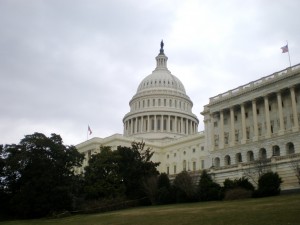 As Congress discusses making significant budget cuts, cycling and programs that encourage multi-modal transportation options are almost sure to be under threat.
 There are a number of reasons why clinging to the curb is a really bad idea: