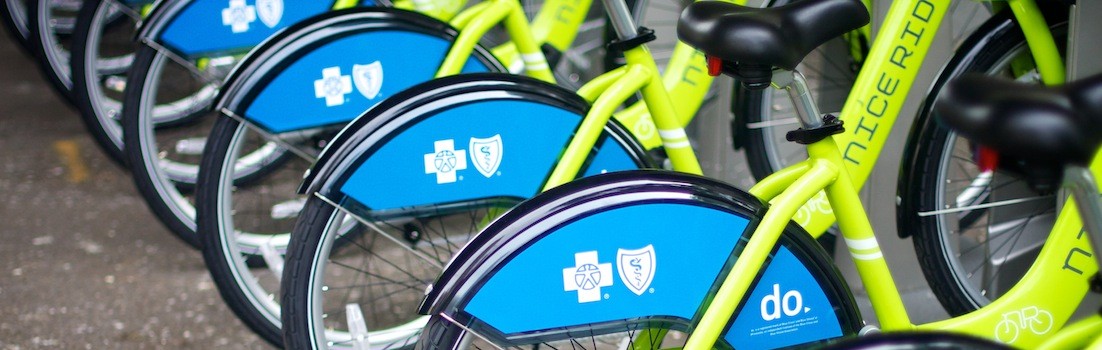
In Minnesota, bicycles are considered vehicles, and thus subject to vehicular code.
That is, save in two cases of which I am aware.
First, on a sidewalk (where permitted) or in a crosswalk, a bicycle becomes a special sort of pedestrian.
Second, all those state and county parks that have vehicle permit requirements? Not for bikes! Yahoooo! Thus, the ability to ride over to the Coon Rapids Dam without paying the nice ranger at the gate.
Awesome.
August 23, 2007
by julie Comments Off on Dinkytown Bridge Re-Opened
With the Dinkytown Bridge re-opened, back-to-school just got a whole lot simpler at U of M. I can’t imagine what a pain it would have been to have that closed for the start of classes.
Cyclists are still ‘short’ the bridge at 10th, but that stands to be the case for a good while. The Dinkytown Bridge wasn’t really being used for I35W bridge recovery efforts, and the closure was just political hoo-ha.
Thinking about it, it ought to be interesting to see what controversies the increased use of 4th Avenue and University Avenue by cars creates as fall commences. Those are major cycling thru-ways for U of M students, and vehicular traffic has increased a lot there.
August 18, 2007
by julie Comments Off on Transportation Policy: Pretty Messed Up
So, living here in the land of ALL BRIDGE ALL THE TIME, I’m getting a close-up view of how messed up US transportation policy really is.
A lot of infrastructure’s been neglected, or taken for granted, in the era of ‘no new taxes’ and small government. One bridge collapsed. Others are on the line for replacement, and were even prior to this collapse.
A 10-lane bridge with a bicycle crossing has been proposed to replace the I35-W bridge. That’s fine. I’m in favor of building as many roads with suitable infrastructure for cyclists as possible. There’s debate about building the bridge to accomodate light-rail transit (LRT) as well. A line is under consideration to run very near there, over a bridge that is basically fine… but would need a huge overhaul to handle trains.
It’s being said that the feds won’t help fund such a construction project, but will only replace the bridge with a similar bridge (no rapid transit). This is pretty messed up. If when infrastructure needs drastic work — and many highways, as well as bridges, do and will — if we cannot adapt them to forward-looking uses, what’s the freaking point? We can add lanes for more car traffic, but not mass transit, under this formula. What?
Cranky.
August 17, 2007
by julie Comments Off on Madam Secretary Says: Cycling Isn't Transportation
Secretary of Transportation Mary Peters appeared on PBS on August 15 to discuss federal transportation funding in the wake of the I35-W bridge collapse. Cyclists and others may be surprised that she considers funding funneled into programs like ‘bike paths, trails and lighthouses’ as spending not related to transportation.
These two quotes are separated in the conversation, but the first is really required to give context to the second:
MARY PETERS: You know, I think Americans would be shocked to learn that only about 60 percent of the gas tax money that they pay today actually goes into highway and bridge construction. Much of it goes in many, many other areas.
…
GWEN IFILL: Aren’t many of those projects, even though they’re special interest projects, aren’t they roads and bridges, often?
MARY PETERS: Gwen, some of them are, but many of them are not. There are museums that are being built with that money, bike paths, trails, repairing lighthouses. Those are some of the kind of things that that money is being spent on, as opposed to our infrastructure.
Bike paths and lighthouses ARE infrastructure. Transportation is not only about highways. Lighthouse maintenance (and construction) is traditionally used in college economics courses as an example of a ‘public good’ — something that governments build for safety purposes that may not be suited for privatization. And proper road planning where bicycles are accounted for can often include some form of ‘bicycle path,’ such as Minnesota’s various bridge projects where bicycle river crossings have been incorporated (such as the I494 Wakota Bridge, the I35E Lexington Bridge, and even the long-term plan to turn the Stillwater Lift Bridge, the least ‘sufficient’ bridge in the state, into a cycle/pedestrian crossing only).
The League of American Bicyclists has prepared a response, and encourage cycle-minded citizens to contact Madam Secretary with their own views on the subject.
August 15, 2007
by julie Comments Off on Rural Riding
After a weekend spent riding in rural areas, I am reminded of a number of rural riding ‘coping techniques.’ I use the term coping loosely, as rural riding offers the bucolic pleasures of cows, pastures, and miles without traffic controls. However, for those used to distance riding in more urban areas, some things are quite different.
Water is always available. Cheap yellow beer is always available. Don’t count on anything more. I’ve found that carrying a ziploc with enough Gatorade powder or even those ‘single serve’ TANG packets designed for use with bottled water is really helpful. (Note to the unfamiliar: I love TANG. If it’s nutritious enough for astronauts, it’s good enough for me!)
Know that a bar may be your best stop opportunity. In the country, everything is a bar, often with off/on-sale, and propane exchange. If you get water and use a restroom, try to buy a Snickers or something. Be nice to the nice proprietors, who think your nice little spandex pants are a little bit fruity.
Watch out for cow turds in the road. This is self-explanatory.
Railroad crossings are often pretty old-school in a lot of rural areas, meaning they eat tires. Watch for the signs and be prepared to slow, stop, and even carry that bike across.
Carry a bit more than a tube and a patch kit. I recommend electrical tape. There are only about 5 things that can’t be fixed with electrical tape (exaggeration).
None of this should suggest opposition to the country. Some of my best riding experiences have been deeply rural. I’ve had Mennonite families refill my water bottle and give me apples. You don’t get that in Minneapolis. But you need to be more prepared, or be with some prepared people, in the country. There are fewer rescue points, and if you get stranded or bonk… hoo.