For those cyclists interested in a unique long-distance touring experience, the Minnesota Randonneurs are holding a conference on Saturday, February 19 from 10 am – 3 pm.
Randonneuring is ta form of long-distance cycling that demands both endurance and self-sufficiency. Riders typically cover 100k – 1200k over designated routes, within specified time limits. It is not a race, however.
The conference will discuss how to start randonneuring, as well as discuss the most famous long-distance randonneur events in the world – the Paris-Brest-Paris 1200k.
This coming summer – and possibly in following years – the Midtown Greenway will have some reroutes and access point closures near Lake Calhoun. The reason? Minneapolis can either proactively replace a decaying sewer line, or face reroutes as a result of raw sewage getting free.
Obviously, fixing is a far superior choice to having raw sewage in parks, backyards, and the lakes.
Greenway users will not, for two months this summer, be able to enter and exit the trail onto Dean Parkway. Crews will need to dig around the ramp there to properly bury the pipe. Gordon said he is asking the Hennepin County Regional Rail Authority about making a temporary entrance one block east at Thomas Avenue.
Without the Dean Parkway ramp, bicyclists will have to go west to Whole Foods or east to the Lagoon to get on or off the trail.
In a few places, the repair work will require digging under the Greenway. Route-arounds will be constructed to allow traffic to get through. I expect that those spots will demand some etiquette from cyclists and pedestrians alike, as such re-routes tend to be narrower.
The Swedes are good for more than just delish meatballs, lingonberries, and glögg. Club Global has published a manual from their “Cycling for Everyone” program. It’s available in both English and Swedish.
Much like the League of American Bicyclists’ Traffic Skills 101 curriculum, the “Cycling for Everyone” course is designed for use with adults. One difference is that TS101 is intended for individuals who already know how to ride a bicycle (the mechanics) who want to learn more effective practice of cycling, and the “Cycling for Everyone” addresses adults who have never learned to cycle, or who have been off the bike so long they need a refresher.
The published manual is intended for instructors of cycling more than it is for students of cycling. There are a number of interesting passages in the manual, but this in particular struck me given my recent musings on fear and safety:
Despite everything we read in road safety campaigns, it is important to remember one thing – cycling is not dangerous. Obviously, make sure the bike lessons take place in a safe manner. We hope this goes without saying, but to teach an adult to ride a bike is not a high risk activity. Its not like teaching parachuting or deep sea diving. In all probability the biggest obstacle for the prospective cyclist is their own fear. You should definitely not start the course by citing fear-provoking examples of how dangerous it can be to cycle. That would be downright counter
productive.
Right now, the “Cycling for Everyone” program is in its infancy in Sweden, but it may serve as an interesting model for advocates in the United States looking to reach immigrant populations and other underrepresented groups in which many children and adults may never have learned the basic skills of bicycling – let alone rules of the road or other niceties of effective cycling courses.
Yesterday, I talked about how bike education tends to be marketed based on safety, and that safety messages are fundamentally rooted in fear. This kind of message is fairly effective to reach the 60% of people who are interested in riding more, but concerned about traffic and safety issues. The challenge of how to make the marketing message not a self-perpetuating theme can be tackled by educators in the content of their courses – providing solid skills and statistics to grow rider confidence and create perspective on relative risks and rewards.
The 8% of cyclists who are confident or fearless, however, pose a variety of challenges to bicycle educators and advocates. Some of this 8% are very effective cyclists – from lane positioning to trail etiquette and appropriate compliance with traffic control devices, they do a pretty good job. Some of this 8%, however, aren’t effective cyclists. They’re very effective at creating bad public relations for those cyclists who are, however.
Safety isn’t a message that has meaning to the cyclists who willfully go the wrong way in traffic, blow stop signs, disregard other trail users, and otherwise earn the negative comments so common online about cyclists. Their behavior ends up harming the portion of the 8% who don’t ride like jerks, and provides an additional deterrent/concern for that 60% who might be persuaded onto their bikes more frequently in the presence of better infrastructure and good bicycle rider training.
As I said: Once you get the 60% in the room, you can provide statistics and skills to balance out their perception of fear. How do you get the fraction of that 8% who ride like jerks in the room? Not only do you have to reach them in the sense of getting them to listen, but then you need to package the bicycle education message in a way that has meaning for them. They already feel confident. Safety isn’t a good message for them, because seriously: If safety is a big concern you don’t blow traffic signals in the presence of traffic.
I think this question is harder to answer than the 60%, but is still worth answering because of the damage that over-confident cyclists who ride any-which-way do to the cause of getting the 60% more involved, and that they do to the overall goal of greater acceptance of cyclists as traffic. Unfortunately, I don’t know that anyone’s come up with a good response to this problem, because the psychology of it is daunting, and the population to be reached with the message is such a minority compared to the easy pickings and quick wins represented by the 60%.
February 3, 2011
by julie Comments Off on Safety, Fear & Bike Education
One of the greatest barricades to the success of bicycle education in this country is that the core value proposition marketed for it is ‘safety.’
Nothing is wrong with safety. Effective bicycle drivers exhibit behaviors that add to their safety.
But let’s be honest: The fixation on safety is born of fear. Fear of the road. Fear of cars. Fears that may or may not have anything to do with actual statistics, and fear that can be mitigated though appropriate bicycle driving behaviors.
Safety and fear also end up as poor marketing messages to another whole segment of the biking population: Those who aren’t scared. Unfortunately, for many of these riders, a few tips on effective riding would really be a good thing. However, they see bike education as something for the novices and the hesitant. Safety is boring.
Studies suggest that the confident and/or fearless cyclists make up about 8% of the population. Another 60%, though, rate as “Interested But Concerned.” Finding ways to get these people on bicycles is essential for the growth of active transport in this country, as it provides significant political and social support for the practice.
As well, data from Portland (OR) and New York City suggest that cycling may improve traffic safety overall – not just for cyclists. More cyclists and greater acceptance of their road rights lead to greater caution shown by motorists and others.
There are a lot of challenges in the fear message. As Elly Blue writes in a great piece entitled Don’t fear riding a bicycle, “The real thing that’s killing us is that we continue to create places that impose barriers to actually being able to move your body.”
Roadway design and Complete Streets policies help, both with removal of barriers, and mitigation of fear. Providing a variety of different on- and off-street options for cyclists is typically more effective than trying to convince people that they’re being irrationally fearful, although it can be expensive.
Education, while less expensive, continues to have a lot of marketing barriers and participation issues. Programs like Bikeability in the UK show one model of removing the fear-safety marketing and achieving widespread participation. Various programs in the US take innovative approaches to increasing participation rates. But many programs continue to be marketed with fear as a motivator, and I think that ends up counter-productive to the movement as a whole. While there there is clear basis for the target audience being receptive to a message of fear, fear also prompts people to keep their kids inside, not ride themselves or only ride on recreational trails and not for transport, and other limiting behaviors.
The safety and fear factors should be kept in mind by cycling advocates when working for bikeway development. The interested/fearful population do not think that cycling advocates are ‘like them,’ and really – bike advocates tend to be confident and passionate, and thus somewhat separated from the fear. The confidence can even be off-putting to those who are generally fearful. This is not to say “become less confident,” but consider how to make projects relatable to that group without relying too heavily on perpetuating fear. Together, advocates can come up with positive approaches and achieve greater buy in with less fear.

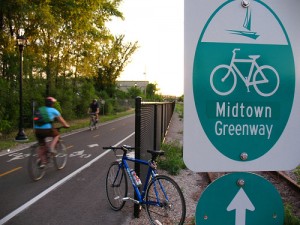 This coming summer – and possibly in following years – the Midtown Greenway will have some reroutes and access point closures near Lake Calhoun. The reason? Minneapolis can either proactively replace a decaying sewer line, or face reroutes as a result of raw sewage getting free.
 The Swedes are good for more than just delish meatballs, lingonberries, and glögg. Club Global has published a manual from their “