Not much to say here save that Grist has an epic, epic post – with pictures! and video! – of bike plows in different places around the world.
Go read it, for it is super awesome.

February 2, 2011
by julie
Comments Off on Epic Story on Bike Plows
Not much to say here save that Grist has an epic, epic post – with pictures! and video! – of bike plows in different places around the world.
Go read it, for it is super awesome.
February 2, 2011
by julie
1 Comment
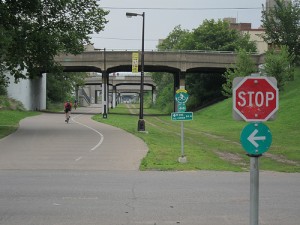 Many novice cyclists believe bicycle trails are safer than riding on the road. The core reason for this? Cars. Unfortunately, there are a lot of reasons this is potentially misguided – from the unpredictable behavior of trail users to the sorts of at-grade crossings used on many trails. Local trails, such as the Gateway Trail and the Cedar Lake Trail, have been struggling with crossing issues for many years.
The Rails-to-Trails Conservancy deals with many of these issues regularly as they work to transform old rail corridors into safe cycling corridors. They just released a report of methods that can be used to improve trail crossings, including at-grade mid-block crossings of multilane roadways. The report includes examples of the treatments used together and examples of improved and planned crossings in California.
The report is extremely realistic about the challenges in creating good trail user experiences – geometric constraints, financial resources and incompatible adjacent land uses are all issues for trail planners. Many ideas are offered that are financially more attainable than the creation of expensive bridges or tunnels. It would be good to see more of these methods used on local trails in order to make them more friendly to pedestrians and cyclists.
Image by Michael Hicks, via Flickr.
February 2, 2011
by julie
Comments Off on Thoughts on Bikeway Planning
 Regular readers of this site will know that I can be a bit of a crank about certain types of bicycle facilities:
Generally speaking, every type of bicycle facility has its own drawbacks. Frequently, the choice of implementation is based on familiarity or ease, rather than a real evaluation of the different drawbacks.
That’s why this article on Bikeway Network Recipes is interesting. The author rightly views all of the options as part of a toolkit. She specifically cites the Copenhagen cycling network – often held up as a model by others – and calls out the drawback found by some residents of that city: That inexperienced cyclists (and parents of small children!) are uncomfortable with them and thus don’t use them!
Her recommended recipe is to take advantage of the relatively easy-to-implement bike lanes and boulevards while also working on some of the high-profile, harder to implement and more expensive projects. In the Twin Cities, examples of this kind of split would be the Jefferson Avenue bicycle boulevard in St. Paul (fairly cheap, and really just a paint job indicating what locals already know to be true), and the Cedar Lake Trail extension (years in the making, fiercely expensive, but a needed piece of the network).
I especially like her thought to start wherever you can – and to keep going. The money quote, though:
…if there’s no reaction in the media, business community, or neighborhoods, you probably haven’t done enough – because you need to have the changes be visible enough to provoke a spirited conversation about bicycling as a mainstream form of transportation.
And that’s really what we need – a view of cyclists as the norm, and not freaks or fringe.
January 28, 2011
by julie
Comments Off on Education & Children’s Cycling Behavior
 Via the League of American Bicyclists’ LCI group, I recently learned of this study from the UK that examines the impact of a cycling training program on the bicycling behavior and perceptions of children who have gone through the program.
Bikeability is a public-private partnership in the UK that teaches cycling skills for the 21st century. Three levels are taught, each awarding “certificates and shiny luminous badges” for children who complete each course. The website for the program is brilliant and quite a lot of fun (example: “If you are a child and you want to do your Bikeability, speak to your mum, dad or guardian. Or hassle your teacher at school!”)
To gauge the impact of the Bikeability program, a survey was conducted on behalf of Cycling for England and the Department of Transport to establish attitudes towards cycling, current cycling behaviour and awareness of, participation in and experience of Bikeability. While Bikeability is available to all ages, the survey focused on children in school years 5 and 6 and their parents.
Key findings:
Per the study, participation in the education program encourages children to make new types of journeys using their bike. Children who have taken part in the program are more likely to cycle to get to places (friends’ houses, shops) and more likely to say that they always cycle on the road than those who have not.
This is a powerful study with potential application into the United States. A program of bicycle education for children is highly compatible with Safe Routes to Schools, and could be executed using League of American Bicyclists curriculum as part of a SRTS program. Many schools who take part in SRTS and who receive grants from the program do various levels of training and outreach to students and parents to encourage safe cycling behaviors. This study suggests that putting together a more comprehensive program that can be implemented at the local level using national curriculum could be a powerful driver of increased cycling and confidence.
Photo by David Kelly, via Flickr
January 28, 2011
by julie
1 Comment
Summaries of the 2010 pedestrian refuge test at Cleveland and Jefferson Avenues have been published by the Mac/Groveland community council. This is the latest bit of data to be thrown into the ongoing debate about St. Paul’s attempt to turn Jefferson Avenue into a formal bicycle boulevard.
Per the Transit For Livable Communities summary of the data, there is clear evidence that a number of the concerns expressed by those expressing opposition to the project are not sustained by traffic study data.
As I’ve previously discussed, this is mostly a matter of formalizing something that’s been essentially true for years. However, a stink is being made of it by people who are concerned about the traffic calming impact, parking impact, and the horror of formally sharing the streets with bicycles (instead of the somehow informal arrangement that exists). Jefferson Avenue was designated as ‘bicycle friendly’ on a 1998 bikeways map published by the Metro Transit Chain Gang.
The pedestrian median appears to be useful. The lingering debate about the sharrows and other paint/signage on Jefferson continues to flirt with ridiculousness. Jefferson is already recognized as a good route by many local cyclists, and is designated as such in many resources designating good routes in the Twin Cities. The paint job is just PR, and not an especially impactful improvement to cycling in St. Paul. Now, if they’d work with the ongoing trauma of going north-south in the city, that would be a delight.