Here’s a point of opposition that I’ve never seen before: A Republican candidate for governor in Colorado claims that bike-boosting policies advocated by Denver’s mayor are “converting Denver into a United Nations community.”
This isn’t from some Interweb humor site – it’s from the Denver Post!
Apparently, the new bike-sharing program in Denver (which is not dissimilar to Minneapolis’ Nice Ride program, as I understand it), puts the environment above the rights of citizens. Apparently this is based on Denver’s membership in the International Council for Local Environmental Initiatives, an international association that promotes sustainable development.
Somehow, promoting environmentally-friendly initiatives that are also favored by ICLEI ties US cities closer to the UN, and sacrifices US citizen rights and sovereignty to the UN.
Uh. Whatever?
July 29, 2010
by julie Comments Off on Update on Minneapolis 2-Way Street Initiative
Last fall, Minneapolis took Hennepin Avenue and 1st Avenues in downtown from one-way streets to two-way streets. This was a big deal, both from people in favor and people who were horrified.
In the sense of promoting more people coming downtown, it probably was a net good – one-way streets confuse people who are not near them every day and who are in for a special event (theatre on Hennepin, a Twins game, whatev).
They’ve published an evaluation of the conversion. Because this study was performed by the same agency responsible for the conversion, there is a bit of a question of impartiality, but data is at the base of most conclusions:
Bicycle traffic is up, based on user-count metrics.
Allegedly, there have been no bike crashes on Hennepin since conversion, whereas prior it was known as one of the worst ‘bikeways’ in the city because it violated every principle of bicycle lane planning ever created. (I’m a bit dubious that it went from apocalypse to idyllic – I’m wondering about reporting, personally.)
The city claims people have figured out the odd parking/bike lane configuration.
When you dive into the stats, it turns out that bicycle traffic on Hennepin Avenue alone is down by about half. The increase is based on a combination of Hennepin, 1st, and Nicollet. Apparently, some people really liked the bike-lanes down the center configuration on Hennepin – a configuration that almost undoubtedly was a part of the crash statistics, and may have led to more serious crashes due to the physics of bicycle-vs-car based on lane placement and speed.
I think the parking zone/bike lane setup remains the most confusing element of the conversion. Flipping them around does put the bike lane in the door zone, but that’s a more common configuration, and motorists and cyclists typically know where they’re supposed to be in such a setup. The city have stated that they intend to paint all of the shared lanes for vehicles/bicycles green, particularly on Hennepin. Buffer zones are to be added between the bike lanes and parking zones on 1st Avenue to reduce dooring risk and facilitate use of the parking areas by handicapped vans with ramps.
July 24, 2010
by julie Comments Off on Saint Paul Bicycle Coalition Forming
In the ongoing movement for municipalities and cities to have their own advocacy groups to extend and support the work of state-wide organizations like the Bicycle Alliance of Minnesota, a new bicycle coalition is forming in St. Paul.
Locally-oriented groups are a key piece of the advocacy puzzle, as they are typically made up of local voters who live within a city or town. As constituents, members can further local and state-wide initiatives more effectively than state-wide groups coming in without the local support.
The group is involved in the attempts to extend the Midtown Greenway via the Ayd Mill corridor, and are also meeting monthly on the second Tuesday. If you’re a St. Paul resident, consider hitting their August 10th meeting.
Pedicab quandary in St. Paul: Basically, pedicabs aren’t regulated in St. Paul, and there’s a question of if adding regulation would protect operators. It probably would, if St. Paul were capable of sensible regulation – something that can be debated.
There are some classic St. Paul-isms in this article that point to that very concept:
The woman and seven officers convened on the scene, where they talked for two hours before reaching a decision to ticket him.
Uh, two hours? Awesome.
Edina Bike Trail Controversy: Edina want to build a bike trail via the Nine Mile Creek watershed/wetland. A bunch of neighbors are opposed. Those opposed to the opposed neighbors are making it out to be NIMBYism. The opposed claim it’s about suitability because of the wetland nature of much of the route. Various groups are building websites and Facebook groups around their positions.
I’m not familiar with the entire run of the trail, but I suspect a middle ground is pretty accurate. The public land is pretty narrow and tends to mud, high water during spring thaw that creates trail erosion and maintenance issues and, of course, skeeters. (It’s a creek!)
There are a couple of quotes around facilities issues in the Strib piece that stick out:
“Just like you don’t put a playground in a parking lot, I wouldn’t put a bike trail on a roadway unless there is completely no other way.”
That’s because when you build it on-street, it’s definitionally not a trail. Depending on construction protocol, there are lots of terms for on-street bikeways. Bicycle facilities encompass a lot more than happy little trails.
For me, it also comes down to a question of purpose. It appears the approach is as a recreational trail. A roadway route has greater merit in connecting bicycles to destinations and driving greater multi-mode adoption. Many end-to-end recreational trails, particularly smaller ones in neighborhoods, don’t actually have a lot of community impact on mode shift. As such, I’d rather see them working on on-street facilities that help connect users to community destinations, rather than happy views of the creek.
Legal Roadblocks to Greenway Extension: A judge has ruled in favor of the Canadian Pacific in a right-of-way dispute over the Ayd Mill railway corridor, a target for those who wish to extend the Midtown Greenway to downtown St. Paul. There is a meeting about ongoing vision and next steps for Greenway extension planning on July 28.
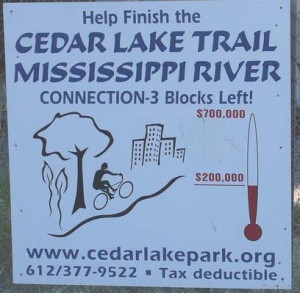
There’s been a bunch of coverage of the final phase of the Cedar Lake Trail. After years of right-of-way issues, the construction of Target Field, and funding, the final easement to extend the trail to the river has been acquired.
The timing for this is interesting – because of the many issues with right-of-way, as well as building a mile of trail through the densest part of the urban core, this is going to be monstrously expensive. Estimates for the total cost of this last segment exceed $9.2 million dollars, paid via a combination of state funds, federal earmark, donations and even funds from the city of Minneapolis.
A lot of people question this expense, particularly at a time of challenging federal, state and municipal budgets.
One thing to keep in mind is that this won’t ever become any cheaper, short of a zombie apocalypse that devastates that piece of Minneapolis and makes the construction easier. Costs to get the construction going are cheaper now than at any time in the recent past, due to high labor supply.
The maze to get from the de facto current trailhead to the river frustrates many. Some of the city’s recent shenanigans with parking, bike lanes, taking streets two-way from one-way, and etc. haven’t helped. Obviously, this of itself doesn’t justify expense – but the completion has been planned for many years.
Completion is scheduled for November. I am assuming that the extension, like the rest of the trail, will be plowed during the winter, adding to the Minneapolis commuter trail network that is quite workable even in the nastiest months of the year. However, it’s always good to confirm plowing each year – budgets being what they are.
 Here’s a point of opposition that I’ve never seen before: A Republican candidate for governor in Colorado claims that bike-boosting policies advocated by Denver’s mayor are “converting Denver into a United Nations community.”
 There’s been a bunch of coverage of the final phase of the Cedar Lake Trail. After years of right-of-way issues, the construction of Target Field, and funding, the final easement to extend the trail to the river has been acquired.