Ride Boldly!

Bikes, bicycling, and road safety.

May 2, 2012
by julie
Comments Off on Non-Motorized Transportation Pilot Project Summary Report Released

Non-Motorized Transportation Pilot Project Summary Report Released

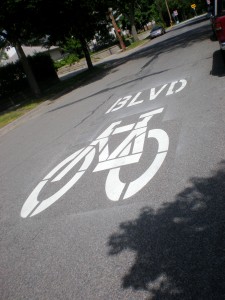
Minneapolis Bike BoulevardYesterday was the big day, finally. After several “delivery dates” came and passed, on May 1, 2012 the FHWA finally delivered the Non-Motorized Transportation Pilot Program report (PDF). I wrote quite a bit about it at Streets.MN yesterday.

Your quick summation is: Yeah, when you spend $25 million dollars to shift demand and modeshare, you shift demand and modeshare. There’s a certain extent to which this conclusion should merit a hearty “duh” from pretty much everyone. (Give me $25 million bucks, and I bet I can make a few people believe the health benefits of breaking beer bottles and using the glass shard as pasta sauce. Marketing!)

The big challenge is going to be how different people feel about the value of these shifts. The ROI, if you will.

For $100 million dollars — the total investment across four pilot sites, including Minneapolis — you can typically build about five miles of four-lane highway in an urban/suburban area. It doesn’t get you very far. (For comparison, the St. Croix Bridge to Sprawl? It’s going to cost a hearty $600 million or more, to serve roughly 12,000 vehicles/day.) So you might think the following numbers would seem like good value:

  • For the four pilot communities, bicycling mode share increased 36 percent, walking mode share increased 14 percent, and
    driving mode share decreased 3 percent between 2007 and 2010. In Minneapolis, bicycling mode share increased by 33% and walking mode share increased by 17%.
  • In 2010, an estimated 16 million miles were walked or bicycled that would have otherwise been driven –  32 million total driving miles were averted between 2007 and 2010.
  • The pilot communities saved an estimated 22 pounds of CO2 in 2010 per person or a total of 7,701 tons. This is equivalent to saving over 1 gallon of gas per person or nearly 1.7 million gallons from 2007 to 2010.

Approximately $89 million of the $100 million was spent directly on infrastructure. In the Twin Cities, it was actually near 87%, with many projects still in progress — or, roughly $21 million in infrastructure spend. There are citable studies that say building bike infrastructure builds jobs pretty efficiently. (I’d have loved to see figures on job creation in this report, but I doubt it was tracked, especially in the early years.)

From here, the debate moves to the ongoing standoff over transportation enhancements and the transportation bill. I think a certain level of angst is yet to come concerning the maintenance and upkeep of the infrastructure that’s been created in the four communities — infrastructure everywhere is suffering right now. Money is being poured into “new” and existing is decaying. And let’s not even mention the Sabo Bridge, which is one of the local investments, and already facing problems.

Me? Imma go ride my bike.

April 27, 2012
by julie
Comments Off on Physics, the Law & Tragedy

Physics, the Law & Tragedy

Another cyclist fatality is in the news, this time in the suburbs, where a 17-year-old was hit by a car when leaving church. As usual, the news coverage has been very conscientious about making sure we know the helmet status of the teen. As a change-up, they are also discussing other factors that led to the tragedy — physics, traffic law and what the Strib is calling “bad timing:”

  • The kid was leaving church at 8:45 PM and had standard reflectors, but no powered lights. As such, in Minnesota in April, he was riding in the dark without the minimum lighting requirements outlined in Minnesota Statutes 169.222.
  • The teen was moving against traffic flow, moving northbound in the southbound lanes of Shady Oak Road, which is a minimum of a 35mph zone near the accident location (but may be a 45 zone). Per Google Maps, the area near the accident site lacks shoulders, but has a protected sidepath on one side of the road.

Traffic law in Minnesota, and most science-based states, has cyclists move in the same direction as vehicular traffic. It helps put them within the most typical scanning zone of vehicle drivers, particularly where driveways and cross-streets are concerned. In addition, when a car moving at speed head-ons a bicycle, it really won’t matter if the cyclist is helmeted. Physics tells us that because both bodies have momentum, the force output is much greater. Because a car is heavier and moving faster, the output of the collision is going to wreak havoc on the cyclist.

Regulation lights would have helped in this case, because a collision of this nature negates the value of reflectors. There may have been a front reflector, but that reflector is less effective than a front headlight. The specific description of required equipment comes from 169.222, Subd. 6:

No person shall operate a bicycle at nighttime unless the bicycle or its operator is equipped with a lamp which shall emit a white light visible from a distance of at least 500 feet to the front and with a red reflector of a type approved by the Department of Public Safety which is visible from all distances from 100 feet to 600 feet to the rear when directly in front of lawful lower beams of headlamps on a motor vehicle. No person may operate a bicycle at any time when there is not sufficient light to render persons and vehicles on the highway clearly discernible at a distance of 500 feet ahead unless the bicycle or its operator is equipped with reflective surfaces that shall be visible during the hours of darkness from 600 feet when viewed in front of lawful lower beams of headlamps on a motor vehicle. The reflective surfaces shall include reflective materials on each side of each pedal to indicate their presence from the front or the rear and with a minimum of 20 square inches of reflective material on each side of the bicycle or its operator.

Pedal reflectors and side-visibility are not going to do a lot to prevent this kind of head-on crash.

The real tragedy of this situation is that is was not inevitable. This is not a situation where there were no alternative routes. Compliance with existing law would have done what the law was written to do — create predictable scenarios for all road users, respecting the laws of physics. And everyone involved in this tragedy would be okay today. Instead, we have one bereaved family, and one driver who is probably terrified of night driving. My sympathy goes out to all parties involved.

April 26, 2012
by julie
Comments Off on Cyclist Recipe: Super-Awesome Vegetable Soup

Cyclist Recipe: Super-Awesome Vegetable Soup

I have been raving on Twitter about the vat of soup I made this weekend. People have asked for delivery.

Alas, no can do. But I am going to offer up the recipe to all biking friends, with a note that this is low in carbs but extremely high in vitamin goodness. You can serve it much as you would a salad with a more hearty meal, or grab yourself a whole-grain baguette and cheese. Or you can eat it when you are less concerned for ride energy, as it’s also pretty low in calories.

And you have to use the anise. It makes this soup. This soup would be sad and without joy without it. Anise looks like a weird cross between an onion, bok choi, and dill. Whack off the part that looks like dill, slice off the other end, and chop as though it were celery or an onion.

Super-Awesome Vegetable Soup
makes: 1 vat

  • 2 cups escarole or kale, chopped
  • 2 cloves garlic, minced
  • 1 cup uncooked onion, chopped
  • 2 cup fresh spinach, baby leaves (or normal spinach, chopped into small shreds)
  • 2 small uncooked zucchini, cubed
  • 1 medium sweet red pepper, chopped
  • 1 medium fennel bulb, thinly sliced (remove green tops)
  • 6 cups low-sodium vegetable broth
  • 28 oz canned diced tomatoes, preferably fire-roasted but the cheap ones will do nicely
  • 1 can white beans, rinsed and drained
  • 1/4 tsp crushed red pepper flakes
  • 2 tsp fresh thyme, finely chopped (or 1/4 teaspoon, dried)
  • 1 tsp fresh oregano, finely chopped (or 1/8 teaspoon, dried)
  • 1/4 tsp black pepper
  • 1/4 cup fresh parsley, chopped (or 1 tablespoon dried)
  • 1/4 cup basil, fresh, chopped (or 1 tablespoon dried)

Take onion and garlic and place in pot with a little olive oil. Sautee until wilted.

Dump in everything else and bring to boil. Simmer for at least one hour. Or, move onions to a crockpot, dump everything else in, and leave on High for 4 hours, or Low for as long as you’re going to be out riding with friends/working/whatevering.

Delicious as is, or serve with some chopped shrimp mounded on top, with a grate of parmesan. It’ll look totally gourmet.

April 17, 2012
by julie
3 Comments

Cycling’s Demand Generation Problem

Bicycling. It’s neat, right? Those who do it like it.

But how do you convince those who aren’t doing it to do it more? That’s the key demand generation problem facing cycling right now. And it’s a filthy thing, but you need to have facility demand to get funding for facilities, but to get more people cycling, you need facilities.

People wave around the data, like how Minneapolis’ bicycle use went up rapidly when they got $25 million to spend on infrastructure, and other articles citing various cities. In 1993, Minneapolis estimated 3,000 bike commuters; in 2010, they estimated 7,000, per the Minneapolis Bike Account.

There’s one problem, from the perspective of economics: Is the increase in riders really infrastructure encouraging demand, or infrastructure meeting latent demand? There’s a big difference between the two. If programs are merely addressing unmet demand in the market, there is a natural barrier to growth and acceptance in place once that pent-up demand has been met.

Even with amazing data sets, it’s hard to determine if increases in bicycle use are a result of demand being let free, or demand being created. The data isn’t amazing, however. And while there’s certainly nothing wrong with meeting unmet market demand, with $25 million to promote it, someone could probably create massive increase in the number of people wearing live puppies as hats. Without broad support, you can’t keep spending money. The total number of cyclists and supporters in Minneapolis remains a minority, as they do on the state and federal level when it comes to funding.

So how does one drive interest and demand? Is it in fact continued infrastructure spending, or are there other approaches? What are they?
Are they cheaper, and thus more sustainable in the near-term, as funding becomes an issue in the current economic climate?

April 12, 2012
by julie
Comments Off on Minneapolis Family Bike Rodeo Alert!

Minneapolis Family Bike Rodeo Alert!

In today’s moment of blatant self-interest, I direct your attention to this weekend’s Artcrank grand opening. As part of the festivities, the bike-friendly folk at Clockwork Active Media Systems are hosting a pre-party for families and kids. Part of the fun will include a bike rodeo, a fine event at which I will be helping direct youthful energy into safe biking outcomes. Or, at least, helping direct youthful energy. We’ll also be helping people adjust their bike helmets.

The party is from 3-5PM at Clockwork, 1501 East Hennepin Avenue, in Minneapolis. You can RSVP to the party on Facebook (not required). Beyond the bike rodeo, there will be treats, lemonade, coloring, hopscotch, balloon animals and other mayhem. At 5PM, interested folk will be riding over for the early shift at the Artcrank opening, before too much beer is spilled and the bikers get crazy.

In summary: Fun. Hijinkies. Kids on bikes with balloon animals. Art. Come on out.