Ride Boldly!

Bikes, bicycling, and road safety.

May 20, 2011
by julie
Comments Off on Minnesota GO Adds Two Workshop Sessions

Minnesota GO Adds Two Workshop Sessions

Minnesota GO

I previously posted about the Minnesota GO project and the scheduled public meetings to help drive their vision statement and policy agenda.

Two additional listening workshops have been added to the schedule: One will take place June 2, online, as a virtual workshop for stakeholders who may be unable to reach other workshop locations (or be busy when one takes place near them). A second Twin Cities session has been scheduled for June 14, at the Mall of America in Bloomington.

Minnesota GO continue to update their website with policy videos, discussions, and input opportunities. Check it out.

May 19, 2011
by julie
1 Comment

U of M Transitway Construction

0saves

More construction news out of Minneapolis: Part of the Intercampus Transitway between the University of Minnesota Minneapolis campus and the Saint Paul campus is going to be rerouted for much of the summer.

Specifically, the section behind TCF Stadium is being rerouted to accommodate LRT construction and the utility work associated with the U’s new cancer and cardiovascular research building. The official detour puts cyclists on University Avenue, which is something of a mess thanks to the LRT construction, and not an appealing prospect for the average cyclist.

Depending on your final destination, you may want to give this area a wide detour during the construction season.

May 18, 2011
by julie
Comments Off on Transit & Minnesota’s Continued Budget Kerfuffle

Transit & Minnesota’s Continued Budget Kerfuffle

0saves

As Minnesota rolls towards budget impasse and probable governmental shutdown, it’s interesting to make note of some of what’s been going down in regards to transit. The legislature has slashed Twin Cities transit funding, although it’s hard to say if that slashing survives in the governor’s office. This is an easy vote to make for many legislators, since they represent outstate districts.

The Star-Tribune published the results of a Minnesota Poll about the budget this past Sunday. In it, many respondents targeted mass transit as a key area for cuts:

For budget cuts, nearly half set their sights on a single target: mass transit.

Asked to choose among several options, 48 percent of respondents favored transit costs as a prime target for cuts. Fifty-nine percent of Republicans said it should be the first area cut.

Luckily, in its analysis, the Strib also called out one truth about transit cuts:

Transportation was the most popular cut, but too little is spent there to achieve meaningful savings. Advocates howled last week when House and Senate leaders slashed Twin Cities bus and rail funding. The total savings — $109 million — is a tiny sliver of the state budget.

Much as outstate legislators can easily vote against transit funding, Minnesota Poll respondents include a proportional respondent base from outside the Twin Cities. Even many suburbanites who may be represented in the poll can easily point to transit to be cut if they themselves are not users of transit.

This “it doesn’t impact me” approach to cuts is short-sighted. Having solid transit within core cities is good for a state as a whole. Providing multiple modes of transportation within core economic zones allows for greater worker mobility. It gives employers access to a better labor pool. It makes staying in state a more attractive option for college graduates and improves the labor pool. It reduces pollution impact, which is systemic within a region, not just within municipal borders.

It’s also worth observing that some people don’t use public transit because reasonable transit is not available to them. That’s an investment issue. When more people can be moved in fewer vehicles, whether buses or vanpools or train cars, it reduces overall congestion versus single-user carriage on roadways.

Transit is actually good for the business climate. A good business climate in the cities lifts the state as a whole. It is actually that simple, even though you can go into a lot more economic detail — and urban planners can and do. And the relative subsidy of transit is nothing compared to the absurd level of subsidy built into gas pricing, let alone the cost of roads and bridges.

$109 million is also fairly minor compared to the amount the state and Ramsey County are proposing contributing to a football stadium that will require significant road enhancements — and that is served by no existing mass transit.

It’s hard to say where the budget ends up. But to be in favor of transit cuts because “I don’t use transit” is short-sighted and wrong. When more people can get around in more ways, the better it is for users of every mode.

May 17, 2011
by julie
Comments Off on Midtown Greenway Detours

Midtown Greenway Detours

0saves

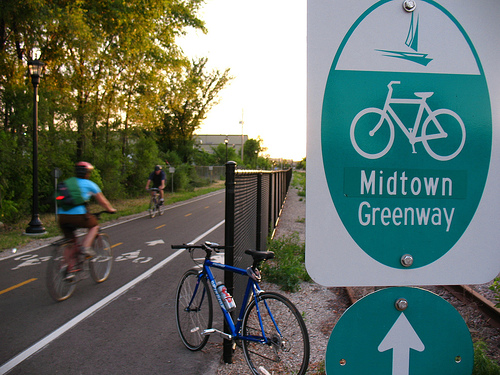
Midtown Greenway, Minneapolis MNThe City of Minneapolis has started various bridge projects that will impact the Midtown Greenway for the immediate future and last through approximately mid-summer, weather permitting.

Regular riders of the Greenway have seen the states of disrepair of many of the Greenway underpasses. A mobile operation will blast loose concrete off underpasses between Hennepin Avenue and Cedar, enhancing safety and cleanliness — in some locations, concrete has been crumbling onto the trail. The bridge work will impact approximately 25-30 bridges. City workers will be working on these bridges during the week, usually during core hours of 7:30-3:30. Closures will be clearly marked and offer reasonable detours for trail users.

Additional bridge rehab work is planned near the Lakes — specifically, on the bridges over the Lake Calhoun-Lake of the Isles Channel, Lake Calhoun Parkway, and Dean Parkway. Work on these bridges will help widen the Greenway and extend the life of these bridges. Trail closures are not expected during this work.

In both cases, cyclists are asked to respect workers and posted closures and detours. In situations where the trail is narrowed but remains open, cyclists are asked to show respect to other trail users in lane placement and travel speed.

More information is available from the Midtown Greenway Coalition.

May 11, 2011
by julie
Comments Off on Duck & Cover: Hail to the Biker

Duck & Cover: Hail to the Biker

0saves

Last night, Minnesota saw some yellow-green skies and golfball-sized hail. Spring has in fact sprung.

This brings up the important safety question of what to do when the sky lets loose and you’re on your bicycle. Generally speaking, if you know there’s tornado warnings, you shouldn’t be wandering on out to go for a nice ride. That’s somewhere between ‘kinda dumb’ and ‘evolution failed,’ depending on the warning and the notice you have, and the sort of ride you’re about to execute.

However, there are days where rain is predicted for ‘after 3.’ You leave at 10 AM, knowing you have plenty of time for some good miles and a stop for a double-scoop waffle cone. You blow a tire, and have to spend a bunch of time stabilizing it with duct tape and a dollar, then you cut your scoop short to a single. And the storm, it seems, is showing up at 2, not 3. In these situations, you need to have a duck-and-cover protocol.

As the sky starts turning green, consider your strategy. Do you know the area? If you’re in the country, is there a town or a gas station nearby? Even if it’s not necessarily in the proper path of your eventual destination, start heading towards the nearest source of shelter. If the sky is putting lime in its coconut, it’s not the time to be concerned about progress to endpoint.

In general, once the sky opens up and is pounding, let alone emitting hail, you should get off the road. There will be some cars who continue in the weather; depending on volume of downpour/hail and visibility, they are dumb. As far as you, on a bicycle, are concerned, the visibility factor is giant. You won’t be able to see or be seen, which can end badly.

Look for some form of cover. In the city, bridges and overpasses can work pretty well. If you’re fortunate, you may be near a shop — or better yet, a cafe. Nearby homes with garages or car sheds may also be an option. In the country, you may have some bridge or overpass options, but often you end up needing to show more creativity. A culvert won’t keep you dry, but it’s a safer place to be (short of flash flooding). I spent one hailstorm in Wisconsin hanging out in a crop-duster shed. If you’re really fortunate, you’ll be near the rural center of action and be able to get in to the town bar. While you may feel weird showing up with your bike and little bike shorts, the locals will typically be welcoming and nice about the fact that you don’t want to be hailed on. Stay away from metal objects, like metal picnic tables, and possibly your bike if you have enough space to put some distance between you and it.

Don’t decide the storm is over too soon. If you have been unable to get into a building situation with wether radio or TV, this can be a challenge. In the situation with the crop duster shed, I was a mile from the rest stop for the event, and I knew there were cookies there (cookies!). I was already soaked. The wind had eased off and the rain was much more sensible. I figured I could make a break for it. About a quarter mile out, POW. Got hailed on. Not recommended. So don’t trust me to give you tips on telling when the storm blew, just try to figure it out and hope.

Be safe out there.