
In lieu of actual content, I will provide you with this image of my angelic little boy discovering a tricycle for the first time.
Real content coming soon. Promise!

April 4, 2010
by julie
1 Comment
In lieu of actual content, I will provide you with this image of my angelic little boy discovering a tricycle for the first time.
Real content coming soon. Promise!
March 30, 2010
by julie
Comments Off on Minneapolis Bridge Closures – 2010
Minneapolis’ Camden Bridge (42nd St N) Bridge is to close shortly for the entire summer, through late October. Vehicular traffic will be detoured to the Plymouth Bridge. Bicycle traffic will be detoured to the I-694 Mississippi River crossing area, although cyclists can also use the Broadway Avenue Bridge or Plymoth Avenue to the south.
This will be especially challenging, as the Lowry Avenue Bridge remains closed/under construction following last summer’s implosion:
(Thanks to Kelly of Adornments with Attitude for the heads up!)
March 28, 2010
by julie
1 Comment
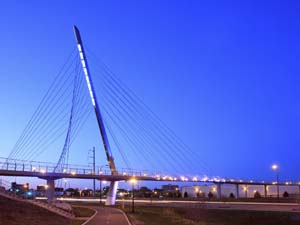 In the upcoming May issue of Bicycling, Mnneapolis is to be named their top city for cycling – beating out perennial favorite Portland (OR). This was somewhat inevitable editorially, as eventually they needed to shake up the list, and it’s easy to give Minneapolis a few bonus points for the fact that our weather is more of a challenge.
However, looking at this another way, this is a win for the Nonmotorized Transportation Pilot Program (NTPP). Established as part of SAFETEA-LU as advocated for by Congressmen James Oberstar (D-MN), the program provided $25 million to each of 4 communities to demonstrate how improved walking and bicycling networks can increase rates of walking and bicycling in communities.
During the National Bicycle Summit, this program was spotlighted in several ways. The Minnesota delegation was privileged to meet with Congressman Oberstar’s Chief of Staff and legislative director, who discussed some of the history of the program. A core piece of the NTPP is that it provided for federal study of mode-shift – key to overcoming objections from some that most studies have been done by local advocacy groups who may not be wholly objective. The pilot report is due in September, but Congressman Oberstar’s staff do not believe it will come through until year-end at the most optimistic.
The Congressman is a strong supporter of the NTPP, but between the lines is was suggested he cannot support expansion prior to the report’s availability due to the commitments he made relative to the original pilot funding’s passage.
This ties into the second spotlight at the NBS for the NTPP: On March 2, a week prior to the Summit, Congressman Earl Blumenauer (D-OR) introduced H.R. 4722, the Active Community Transportation of Act of 2010. The ACT Act calls for “the Secretary of Transportation to carry out an active transportation investment program to encourage a mode shift to active transportation within selected communities by providing safe and convenient options to bicycle and walk for routine travel, and for other purposes.” It amounts to an extension of the NTPP.
As part of the Summit, many state delegations asked for cosponsorship for this bill. As a result, a Bill that started with 6 co-sponsors is now up to 27. The bill has been referred to the Transportation Committee, chaired by Congressman Oberstar, where is is likely to remain until the NTPP report comes out.
However, in the meantime, if you’re excited about Minneapolis cracking the top of Bicycling’s top cities for cycling list, or live in another city you’d like to see get funded to make similar strides, consider writing your Congressional delegate to support HR 4722. Your best bet is to ask them to co-sponsor the Bill – this is the most immediate supportive action a Congressperson can take.
Even if it takes some time to come out of committee, having solid national support will help drive the bill through the Committee and through Congress when the time is right.
March 15, 2010
by julie
Comments Off on Online Responses to Google Maps for Biking
 Now that it’s been live a full 6 days, reviews are coming in on Google Maps for Biking. As with everything involving bikes and media coverage, feedback is a bit mixed.
Wired Magazine are ‘crowdsourcing’ reviews, asking people to try their route and see what comes out of the system. It’s a generally savvy crowd, so they aren’t assaulting Google (or their data sources) for errors.
Meanwhile, others are claiming Google is providing hazardous directions. The notable in this category is the NY Post, who found that Google’s data on NYC bike routes is not accurate. Commenters on this article are embracing the general run of bike-hater joy, discussing running bikers off the roads, how this is all a liberal conspiracy, etc. You know, the usual.
As someone who works with Google services every day (for money!), I’ll say that I come closer to the opinions of the Wired folks. It’s a beta project. The pedestrian walking routes instructions have also been notably erratic (routing people onto highways, onramps, sidewalk-free zones). There are prominent buttons to provide feedback. Garmin and other GPS instructions haven’t been 100% either.
GPS services and Google Maps are always going to be limited by their data sets. I think anyone going somewhere unfamiliar, or coming in from out-of-town, needs to view Google Maps as a guide. Talking to a good local bicycle shop, or a local bicycle club, will ever be your best bet for getting the real (and most current) poop on local bike routes, including road construction, reality of what traffic levels are like, and even if they’re scenic or not. No online data set will ever match the know-how of the local cyclists!
March 15, 2010
by julie
Comments Off on Ray LaHood Announces New Transportation Policy
I’m still processing my volumes of notes from the National Bicycle Summit, and working on posting summaries. For those who know me, I don’t TAKE notes, so the fact that I have 40+ pages of them should be seen as a sign.
 In the meantime, there are some video embeds of Ray LaHood standing on the table at Thursday’s social with Congressional Staff and some core new policy changes, posted at the FastLane blog.
Something the Minnesota delegation emphasized when meeting with Minnesota lawmakers in Washington DC is that most road projects directly and indirectly subsidize automobile use and dependence on fossil fuels and foreign oil. We aren’t anti-car, but we want to see sane planning regulation and principles that give our families and communities safe choices, especially for the large number of daily trips that are within 1-2 miles of our homes.
The new policy guidelines announced today echo that position:
Under the new guidelines, state DOTs and communities are being asked to treat walking and bicycling as equals with other transportation modes, protect and plow sidewalks and shared-use paths the same way roadways are protected, and improve nonmotorized facilities during maintenance projects.
This is all great stuff.
I’ll hopefully be posting my summary later today of the meetings the Minnesota attendees had with Minnesota’s members of Congress, and what you can do to support legislation that furthers these great policy initiatives announced today by Secretary LaHood.