
Ride Boldly!

Bikes, bicycling, and road safety.

March 17, 2011
by julie
Comments Off on Proposed Minnesota Bike Laws: Status Check

Proposed Minnesota Bike Laws: Status Check

0saves

We’ve covered the proposed new bike laws for Minnesota that would add stricter penalties for motorists who injure cyclists and pedestrians while distracted or committing moving violations, HF 68 and SF 201. These laws were also discussed extensively as part of the 2011 Minnesota Bicycle Summit.

Current status of the bills proposed are as follows:

  • HF 68, which provides for careless driving resulting in death to be a gross misdemeanor, was heard in the House Judiciary Committee on February 10, and laid over for further consideration at a later date. It was previously heard January 26 in the Judiciary Policy & Finance Committee. Minutes and audio of these hearings is available online.
  • SF 201, which also provides for careless driving resulting in death to be a gross misdemeanor, was last discussed in the Senate Judiciary & Public Safety Committee on March 1, where it was “laid on the table.” This means consideration of the bill was indefinitely postponed. Audio, video and minutes of that hearing is available online.

No full-body vote on these bills is set to happen anytime soon. Neither is dead, but focus at the legislature is presently on other issues.
March 16, 2011
by julie
Comments Off on Educating Law Enforcement

Educating Law Enforcement

0saves

When we discuss the 5 Es, it’s easy to get hung up on engineering (the process of building bicycle-friendly streets and facilities for cyclists). However, the cooperation of law enforcement can be a big deal for bicyclists. An engaged and educated police force helps cyclists because it understands the rights and responsibilities of bicyclists, and it also helps with PR (because law enforcement may also take action against scofflaw cyclists).

In the Twin Cities area, many local police departments are well-trained about cyclist rights and responsibilities. I have personally had positive interactions with both Minneapolis and Saint Paul police in this regard. Awareness of cyclists and traffic laws can be a little more sporadic in certain counties and rural enforcement areas.

I’m always interested in seeing the materials being used with police departments to educate, regardless of location. The below video is a capture of materials used with the LAPD in Los Angeles, a city that is trying to become friendlier to cyclists, and whose police department hasn’t the best reputation for a lot of things.

Knowledgeable law enforcement is a really big deal for cyclists. At an accident scene, it can be the difference between a motorist getting a ticket or not in some scenarios, and to be frank, it’s a heck of a lot easier to try to press an insurance claim in the presence of a documented moving violation than when the police assume the cyclist is at fault. This is part of the reason the proposed harsher penalties for causing injury accidents to cyclists and pedestrians are important.

March 15, 2011
by julie
Comments Off on Upcoming: Bicycle Safety Event at REI Bloomington (MN)

Upcoming: Bicycle Safety Event at REI Bloomington (MN)

0saves

I will be co-presenting a free seminar on bicycle safety at the REI in Bloomington on March 25, starting at 7:00PM. The title is “Bicycle Safety is a Two-Way Street,” and fellow Minnesota LCI Lisa Austin and I will be covering Minnesota bicycle laws, principles of driving your bicycle in traffic, and other road-sharing concepts for cyclists.

The REI website has pre-registration, but it’s not required. It’s a-okay to just show up. And, as I said: It’s free. I think there will be snacks too, if that’s a motivator.

March 14, 2011
by julie
Comments Off on Biking & Walking in Minnesota Fact Sheet

Biking & Walking in Minnesota Fact Sheet

0saves

As part of last week’s National Bike Summit, hosted by the League of American Bicyclists, America Bikes put together state-by-state fact sheets about biking and walking for use by advocates in their meetings with members of Congress.

Biking & Walking in Minnesota – 2011 Bike Summit (PDF)

The fact sheet emphasizes three key areas: Federal investment in Minnesota, the business impact of biking in Minnesota, and support at the local level for bicycling as indicated by state-level legislation.

Perhaps the most striking numbers are the business impact figures — while the federal investment funds are certainly significant, to budget hawks the spending may still seem like an earmark or other form of funding that can be eliminated in pursuit of budget cuts. However, by establishing the multi-million dollar economic impact of cycling in the state, and the more than 300 bicycle retail stores in Minnesota that represent small business, jobs, and employment, a powerful economic message can be sent.

Regrettably, the figures on the fact sheet don’t line up in a head-slappingly obvious way. The gross revenue of Minnesota bicycle stores is for a single year, whereas federal investment funds are over the period 1992-2009 for Transportation Enhancement Funds, and 2005-2009 for Safe Routes to Schools (basically, since each program’s inception). However, the total investment from 1992-present from these two programs is equal to less than one year’s gross revenues of state bicycle retail stores — which is to say, not including other purchases from other shops or incidental purchases of people on bikes (coffee shop stops, ice cream, etc.). It’s a pretty powerful set of numbers.

States other than Minnesota can also be found at the America Bikes web site.

March 14, 2011
by julie
1 Comment

Spring Bicycle Commuting Tips

0saves

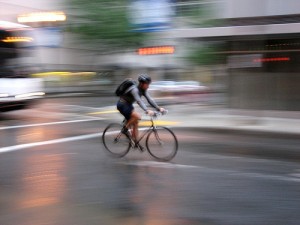
Commuter in rainEveryone gets all a-twitch about winter biking: Tips, cautions, etc. But, when it comes down to it, every season has its challenges for a bike commuter. Spring, often considered by cyclists as a special friend, is its own bag of fun. Now that DST has begun, extending daylight, here are some considerations for your spring bicycle commute:

  • April showers: Rain. It happens. And sometimes it’s not forecasted, or the forecasts end up being screwy. Welcome to spring. It is a good idea to own some sort of raingear. The hardcore bike commuter might consider popping for the complete rainshell-and-pants combo. The more casual bike commuter will still find utility in a rain shell, as they double as a good outer wind layer as well. Find one in an appallingly bright color or with reflectivity, since part of the point is you’re wearing it in suboptimal visibility conditions to start with.
  • More on wet: The giant mounds of snow may still be melting into the streets. Puddles are a fact of life in spring. This will result in wet tootsies. Even if you are not one to wear cycling-specific shoes, you will want to pack along a dry pair of shoes and socks for wear at the office. Wet socks are not only uncomfortable, they get to smelling as the day goes on and will make all of your co-workers hate you. If you bike commute regularly, consider abandoning a pair of shoes at the office for switching into when you get in.
  • Braking & Traction Issues: Only 17% of bicycle accidents involve motor vehicles, per the Minnesota Department of Public Safety. A more frequent cause of pain? Falls due to roadway debris, wet roadways, cracks and other issues. Road grit and wetness can seriously reduce your braking power. Those metal plates on bridges can also be pretty bad when wet. Be aware of all these things when riding.
  • Ziploc = Friend: Giant ziploc bags are good for packing along clothes if you need to do such things. I don’t care how waterproof your panniers/backpack/whatever claims to be. The jumbo ziploc provides you added protection and some security that you won’t be wandering into an early meeting in damp pants that look like you can’t hold your coffee long enough to hit the bathroom.
  • Layers: Everyone talks about layers for winter riding. But in winter, you’re likely to wear the same layers morning and evening. In spring? Don’t count on it. Early in the day, it tends to be cooler, and when you get out, a layer or two less may be called for due to warming during the day. Be prepared to tote the unneeded layers home with you, for you will need them again in the morning.
  • Lights: Lights are needed for winter commuting, because Minnesota gets 3.2 minutes of daylight in the heart of winter. Do not remove the lights because DST begins. All it takes is one jolly good flat and you’re running late, and you’ll be glad to still have them on board. Trust me.
  • Pothole Alert: Spring is pothole heck. Nothing can cheese your nice wheel like an early-spring crater. They may creep up unexpectedly as snow melts, as plows will compress permafrost into the cavern while all is still frozen. Be on the lookout, and don’t haul out your fancy wheels for fun until you’ve seen some public works trucks on the route.