For those not in attendance at the League of American Bicyclists National Bike Summit, here’s a YouTube video of Transportation Secretary Ray LaHood’s talk to the gathered delegates.
As you could perhaps anticipate, it’s definitely the choir preaching to the already-converted, but such speeches are still often fun. This year’s edition is a little more sedate than last year’s, which featured Secretary LaHood jumping on a table.
If you’re interested in seeing more about the national issues being addressed at the Summit with members of Congress, the League’s Summit Program 2011 is also online.
March 9, 2011
by julie Comments Off on New Urban Bikeway Design Guide Unveiled
This year’s National Bike Summit is a bit low-key compared to recent years — the excitement of working with a Democratic president and Democratic-control Congress has been tempered by the midterm elections and the need to work with a GOP House bent on budget cuts. As a result, this year’s big “ask” is that Congress not cut spending for active transport projects. But that isn’t to say that there’s not some good action going down.
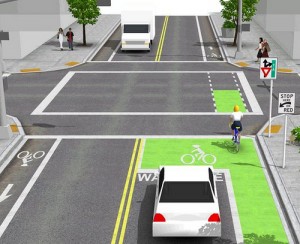
While some of the recommendations are not included in either the AASHTO Guide to Bikeway Facilities or the Manual on Uniform Traffic Control Devices (MUTCD) — which can sometimes limit adoption in some jurisdictions — many of the recommendations are already in use in Minneapolis. Donald Pflaum of the Minneapolis Department of Public Works, a long-time friend to cyclists in Minneapolis, was one contributor to the new guideline process.
The knowledge-sharing embodied in this document is an outstanding tool for cities across the country to tackle creating communities with increased friendliness to active transportation via contextual complete streets solutions.
Image of NACTO bike box by Richard Masoner, via Flickr/Creative Commons
March 9, 2011
by julie Comments Off on Bike League Names 2 New Minnesota Bicycle Friendly Businesses
At the League of American Bicyclists 2011 National Bike Summit, the League named the 2011 recipients of the Bicycle Friendly Business designation. Minnesota is already a leader in this category, with 38 BFBs as of 2010. Two new businesses received this designation today — the City of Minneapolis, and Clockwork Active Media Systems, a local interactive agency.
The Bicycle Friendly Business program is one of several programs within the Bicycle Friendly America program administered by the League, and honors innovative bike-friendly efforts and provides technical assistance and information to help companies and organizations become even better for bicyclists.
With the addition of these two businesses — Minneapolis at the Gold level, and Clockwork at the Bronze — Minnesota has a total of 40 Bicycle Friendly Businesses. At 38 in 2010, Minnesota was the national leader in this designation. I have not yet double-checked, but think it’s pretty likely that Minnesota has kept the crown.
With the Minnesota Bicycle Summit last week and the National Bike Summit this week, I have been noting a pernicious habit among cycling advocates and friends that I wish I could punch out of everyone: Quoting studies selectively or in ways that simply do not apply.
As cyclists and advocates argue for ongoing funding for alternative transit infrastructure in a difficult budget environment, data helps. With those who already support bicycles, data is a tool to offer them to help argue the position or defend their position to others. To doubters, data can be a means to shift opinion.
But using data badly does no one any favors. It’s easily assaulted by opponents. It makes cycling advocates look stupid.
Studies that say more people would ride if more facilities were built. Very often the data collection in these meets appropriate statistical standards. But these really do become a tyranny of the masses — what is popular is not always a good idea. National obesity trends are one example of how what is popular (being sedentary, high fat convenience foods) not necessarily being a good plan. It’s important not to let opinion polling override other forms of science.
The Baltimore study that says that investing in bicycle infrastructure creates more jobs than highway projects. The data in this study is specific to one metro and one series of projects, and is thus difficult to credibly extend across all projects and metros. However, I am definitely seeing bicycle advocacy groups try to do so.
One issue: This is a UK study. The way UK cities and neighborhoods are built around “High Streets” is completely unlike how most of the United States is built. I’ve lived near a UK High Street, when I was attending school in London. Neighborhoods are built around a core intersection/broadway/circus in which most of the basic needs of life can be procured, and major transit transfers are possible.
There are some junctions within cities that act like high streets in the UK — an intersection like Cleveland and Ford Parkway in Saint Paul comes to mind, where you can get almost all the amenities of life within a short walk of the core intersection. But more often the setup is more like MN65 in Fridley/Blaine — a series of strip-malls along a high-speed state highway corridor. To invest on a High Street model would mean blowing up a lot of America to start from scratch.
I’m sure there are more out there that would just make me snarl to hear cited.
Not all studies based on small geography or populations are of no use. The health study in Madison and Milwaukee has broader applicability, because the controlled factors are such that you can credibly say: We don’t know what the total financial savings would be in THIS metro, but based on the savings in THOSE metros it’s pretty safe to bet it’d be a good chunk of change, eh.
I have seen a number of advocacy groups stick to citing well-controlled data studies and facts and figures that can easily be applied within a region without acrobatics. The Bicycle Alliance of Minnesota is one such organization.
As advocates, we don’t need to try to mutilate data to serve our needs. There are studies and data to support our goals that are credible as they stand, without trying to say “we could be more like Europe!” (which is not a good message with even some moderate Republicans, and is often not realistic based on existing build patterns). There are countless health and environmental benefits. There are social benefits. Infrastructure investment can reduce congestion and thus increase business productivity. Infrastructure can attract educated workforces to urban cores. Citing those factors, and data collected in the United States in broadly applicable studies, is going to have a greater impact on fiscal conservatives and the unconverted than using data dodgily.
March 8, 2011
by julie Comments Off on Women & Bicycles
On this International Women’s Day, I thought I’d address one of the skeletons in the room when we discuss bicycle-friendly infrastructure and the interested-but-hesitant cyclist: A pretty good portion of that 60% is female.
One reason for a lower incidence of women on bikes: Women generally have a greater share of responsibility for care of children. Women do more of the household shopping. The study in Scientific American suggests that bicycle routes need to be structured around “practical” destinations to support this gender role behavior. It’s hard to see a lot of average suburban moms hitting Costco on a bike. As I’ve said before: I get it. You won’t be bringing home diapers for two kids, a turkey, and several gallons of milk on a bike while also caring for a child regardless of infrastructure. (SA suggests this can be addressed via education. What?)
Another reason for women to bicycle less than men: Safety concerns. Women are typically found by studies to be more risk averse. The Association of Pedestrian & Bicycle Professionals did a survey in 2010 about women on bicycles. The report is very clear that the sample was not representative of population and also self-selecting — which is to say drawing strong conclusions on the data is fraught with issues. However, the data collected supports assertions that women are risk-averse: Women cited such concerns about cycling as motorist behavior, distracted driving, and stranger attacks.
The APBP study also asked respondents what would get them cycling more. The answers? More than 60% said bike lanes, and another 46% responded with completely separated bike paths/tracks. Better direct routes was also cited by more than 40% of respondents.
Under most state laws, roads are bicycle facilities. We need to find ways to empower the 60% of reluctant cyclists to feel safe on these facilities, and we need to educate drivers not to be jerks. Additional segregated facilities need to be developed based on context — because, yeah, there are some routes on which they make lots of sense — and not based on a knee-jerk belief that they are “safer†or “better.†Segregating cyclists as a matter of policy doesn’t productively further a goal of having bicycling be considered a transport mode, and not a cute little way to get around for hipsters, hippies and people who just aren’t cool enough to have cars.
The challenge is how to calm streets so that all potential users — cyclists, pedestrians, women, kids, the elderly, dogs, etc. — can use them safely and confidently. An additional challenge is continued education to these groups. Bike/Walk Twin Cities have done a number of cycling seminars targeted specifically to women, and manyothergroups have done similarly.
I happen to believe that improving programs like Safe Routes to Schools could help influence women’s participation in cycling. Enabling those who are providing childcare with the means to choose active transport to get to school, athletics/extracurriculars, and even church will help cut down on the number of car trips under two miles.
I think [the bicycle] has done more to emancipate women than anything else in the world. It gives a woman a feeling of freedom and self-reliance. The moment she takes her seat she knows she can’t get into harm unless she gets off her bicycle, and away she goes, the picture of free, untrammeled womanhood. — Susan B. Anthony

 At the League of American Bicyclists 2011 National Bike Summit, the League named the 2011 recipients of the Bicycle Friendly Business designation. Minnesota is already a leader in this category, with