Ride Boldly!

Bikes, bicycling, and road safety.

March 10, 2010
by julie
Comments Off on National Bike Summit Opening Session

National Bike Summit Opening Session

Speakers:

League of American Bicyclists Director Andy Clarke kicked off the proceedings bright and early at 8 AM, clearly freshly caffeinated and excited by having over 700 bicycle advocates and friends of the cycling movement in the house at the Ronald Reagan Building/ITC in Washington DC. He handed it over fairly quickly to Congressman Blumenauer. The Congressman stressed the great strides the bike/pedestrian movement has made in the last 10 years, but also stressed that the need for ongoing involvement and more involved people remains great.

A few highlights from the Congressman from Oregon:

  • He presented the plans for bike lane striping on Pennsylvania Avenue in Washington DC, linking the Capitol and White House.
  • He touted the introduction of HR4722, the Active Community Transportation Act (or ACT Act!).
  • Discussed HR4021, an extension of Safe Routes to Schools that expands funding to high schoolers.
  • Discussed HR3271 Green Routes to Work, and stressed that part of building a bicycle- and transit-friendly America is providing citizens with choices as to how they travel to and from their everyday destinations.

A key message is that we aren’t anti-car, but that much of the funding and legislation has tilted the playing field in favor of the car – even though 30% of all car trips are less than 1 mile! Most people say they would bike or walk more if they felt it was safe or that facilities were available to make it possible (like sidewalks in subdivisions).

Governor Jack Markell of Delaware was next up. Among his campaign events was a bicycle ride across Delaware. He’s especially proud that DE went from 31st most friendly state for cyclists to 9th in only a year. One of the components of that was the passage of a Complete Streets bill to encourage developers, landowners, cities, counties and the state to work together to plan communities and roadways to accommodate all users.

He also discussed the teen labor that work in Delaware beach towns over the summer – many from Europe – and the unique safety issues they’ve presented, and how the state has addressed those issues with education.

He capped his part of the presentation with a top 10 list about riding in Delaware:

  1. You can brag to friends about riding across the state in a morning.

  2. Hills – they’re nice, but they block the view. No issues with that in Delaware!
  3. It’s fun to drop the Governor on rides.
  4. Scrapple.
  5. Punkin Chunkin.
  6. It’s easy to outpace chickens on the roadside.
  7. All their transit buses have bicycle racks.
  8. Politics end on bikes (although he says Republicans have nicer bikes).
  9. You can ride through lots of spray irrigation systems on hot days.
  10. On windy days, you can draft behind fancy Washington DC lawyers on Route 1.

Peter Rogoff, of the Federal Transit Administration, spoke next.

He talked about how policies and programs have to address the new reality. People want choices as to how they get around. Transit use boomed when gas went up to $4/gallon, and has stayed high even as prices have dropped. Many families have dealt with the recession by downsizing – getting rid of a car and going with only one, or no, car.

Cycling and transit, together, create a powerful combination for many families. They need to work together seamlessly and be a credible option.

Thanks to the Recovery Act, transit spending rose 84% in a single year. This has really helped given that many communities have had funding struggles for transit due to the recession’s impact on property tax revenues and other tax streams.

Administrator Rogoff stressed several things:

  • The potential role of bicycles in the First Lady’s campaign against childhood obesity – if kids can ride, they won’t get fat.
  • The need to continue investing even though revenues are tight – transit makes jobs reachable, transit creates jobs.
  • Bicycles and multi-modal options need to be built-in.

The morning session ended with the Googlers presenting the new Google Maps for Bicycles options, covered separately.

March 10, 2010
by julie
Comments Off on Google Launches Maps For Biking

Google Launches Maps For Biking

Today, at the National Bicycle Summit, Google was on-hand for the opening session to launch their newest Maps enhancement: Bike routes!

Peter Birch, Product Manager for Google Earth, was present to introduce the new features. Google Maps for Bicycling has routes and information for 150 US cities, including on-street routes and bicycle trails. Shannon Guyman, another Googler, was on-hand to provide a live demo. Each said that this enhancement is part of Google’s commitment to provide maps for people – not just ‘cars.’

We got a nice live demo, but as always, Google created a nice video demo for the rest of you:

Like other Google Maps options – cars, transit, and walking routes – the biking layer is routable. To provide directions between two places, the algorithm looks for routing info in the following order:

  • Bike paths/trails
  • Dedicated bicycle resources (bike lanes, sharrows, other bicycle facilities)
  • Roadways that have been designated as bicycle-friendly by some data source, often signed routes

The Maps team have also adjusted estimated trip times based on average cycling speeds.

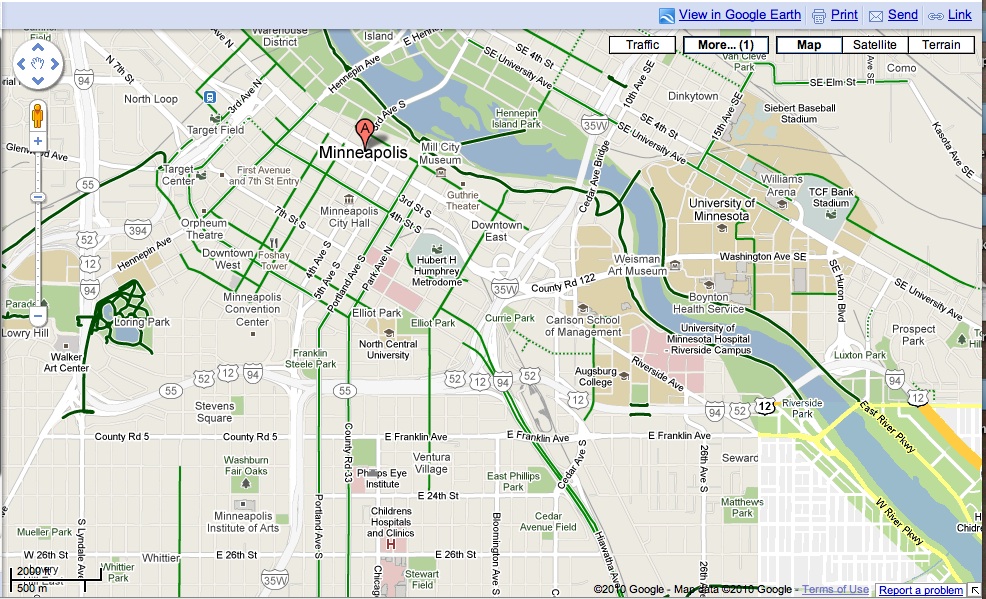
Trails and on-road facilities are marked on the bicycle layer, and okay roads feature a dotted blue line. Minneapolis’ downtown is below (clicky to enlarge):
Google Maps for Bikes

You can either just look at an area, or route between two points. When routing between two points, you can drag the route to change it. To see a local area map, click the ‘More’ button and select ‘Bicycling’ to see suggested routes.

Google is also doing a Twitter content to give away a bike worth up to $2500 of the winner’s choosing. Deets on that are at http://maps.google.com/biking.

I also spoke to the Product Manager after the presentation. Right now, the Bicycle layer is not showing anything more specific in terms of businesses or landmarks than is shown normally. We discussed the possibility of using the Local Business Center data of businesses, many of which are tagged by business type, to potential preference showing bicycle businesses on the map, and adding ‘Bicycle Parking’ as an option for business owners to indicate on their Business Center listings. These are both long-term potential upgrades, which would make for some sweet marketing potential for bicycle-friendly businesses like ice cream shops, cookie parlours, and bike shops.

I know that relative to Minnesota, we have the excellent cycle-route wiki Cyclopath, so some of the locals may not be impressed. However, in a broader sense, this is a good development in the sense that this covers 150 cities and may assist local visitors to various towns – not just MSP. Unlike Cyclopath, this isn’t a user-contributed system, so it may not always provide the best routes. In cases where routes offered are a bit bunk, Google have asked that users provide feedback to improve the system.

March 9, 2010
by julie
Comments Off on New Bikes Belong Campaign: People For Bikes

New Bikes Belong Campaign: People For Bikes

As part of the opening of the National Bicycle Summit, the Bikes Belong Coalition introduced their new advocacy campaign: People for Bikes. The web site is live at http://peopleforbikes.org, and operates on the principle that there are 250,000 bicycle advocates, but 50 million cyclists.

The campaign aims to link the two.

Much of it was developed by a Minneapolis agency, Colle+McVoy. The site is going to be dependent on social media pass-along and print and event advertising, as it’s got no search optimization. (Hey, I’m a geek, sorry. Gotta call it as I see it.)

The next few days should be very interesting. Tomorrow is a full day of sessions, followed by Thursday on Capitol Hill. Dorian, the director of the Bicycle Alliance of Minnesota, says our delegation has a full day planned.

March 3, 2010
by julie
1 Comment

Bicycles & Red Lights

Some time back, I discussed Minnesota Statute 169.06, which allows a motorcycle to stop completely at a red light, but to move on red if the light does not change for an ‘unreasonable’ amount of time and passage is safe. At that time, I said that I knew many bicyclists who used that statute, although there was no known application of the statute to bicyclists.

Turns out that the statute does not in fact apply to bicycles. During initial passage, the word bicycle was stricken from the statute.

Two bills currently in the Minnesota Legislature are working to change that – S.F. 2453 and H.F. 2616. They’re essentially the same bill, only one is the Senate version, one the House. If passed and signed – and it seems pretty uncontroversial – this would bring bicyclists under the statute with clarity.

It might not be a bad plan to contact your legislators and suggest a positive vote on these bills – just to be sure.

March 2, 2010
by julie
Comments Off on Recent News & Headlines

Recent News & Headlines

Been pretty busy lately, but as the (first) thaw gets underway, there are goings on here in the tundra and elsewhere.

  • The Winona Bridge, about which I have written a billion times following its brief closure in Summer 2008, is now scheduled for ‘rehabilitation’ in 2014. Everyone gets to take their chances on this fracture-critical structure until then.
  • A Complete Streets bill is under consideration in Minnesota. I recommend against even going NEAR the comments on the linked article, as they are full of standard-issue hatred of bicyclists and the same tired arguments about licensing, taxes, and etc. that we have heard many times before.
  • City of St. Paul is starting pothole patching this week. Hooray. I think we’ve all encountered a few doozies lately. MPR’s user-driven pothole map is pretty epic.
  • The National Bicycle Summit is next week in Washington DC. I’ll be there! Watch this space for coverage of the sessions, plus I’ll also provide a summary of the bills we’re advocating for on Capitol Hill – the Active Community Transportation Act of 2010, the federal Complete Streets bill, the Urban Revitalization and Livable Communities Act and the reauthorization of Safe Routes to School.