This week’s pretty quiet on the Minnesota Bicycle Event Calendar. The big event to be aware of is the Lifestyle Bicycle Event at the Mall of America Friday-Sunday. It’s put on by HaveFunBiking.com with participation from the Bicycle Alliance of Minnesota to provide a variety of educational experiences to encourage people to ride their bicycles this spring and beyond.
And, of course, DST begins. It extends daylight to help more people bike commute!
#bikeschool on Twitter, normally on Thursday nights, will be taking a spring break this week. Some of the usual suspects may tune in anyway and discuss Taco Making Robot.
Another Reason to Complete Our Streets — The Minnesota 2020 blog looks at the value of Complete Streets for older citizens, with links to additional studies and articles.
Bike Lane Meeting Gets Hot — Meanwhile, in Brooklyn, New York, a controversial bike lane project continues to create insane public meetings. At this one, covered by Transportation Nation, the chief opposition are… local senior citizens. What?
Are People Nicer in Cities? — Wired magazine looks at studies about cities and why they exist, and their benefits/drawbacks. My summary is really bad. Just go read it.
I’ve talked quite a bit recently about how incremental change to encourage active transportation is very much dependent on working to improve existing poor development that can’t just be blown up with a do-over.
I offer today a tale from close to (my) home of good intentions gone awry.
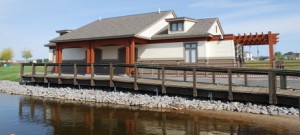
Blaine, Minnesota has been a fast-growing burbclave for some time, with continued addition of new housing units. As part of some development, land was set aside to create a new city park. After last year’s opening of Lakeside Commons Park, it became wildly popular. It’s a pretty nice park — there’s a beach, there’s a splash pad, there are picnic shelters, you can rent canoes for the lake. Very pleasant.
This year, Blaine is trying to address the problem of parking at said park — there simply isn’t enough. One of the reasons is because it is next to impossible to get from one piece of Blaine to another. In the entire suburb, there are limited sidewalks. Crossing MN65 is a horror. Many major streets lack sidewalks, sidepaths or shoulders, and tend to roll in the 40 mph+ zone.
Per the local paper, even the more conservative parking lot extension plan amounts to about half of Blaine’s parks development funding budget for 2011. Half. All on more parking spots.
If you don’t live in the development the park is located in, or one of the developments along Radisson Road, which offers a shoulder and a sidepath along a 55mph roadway, it is nearly impossible to get there via bike. I’m an LCI, an experienced cyclist, and I’ve ridden on roads that would make some people need new pants, and I’m challenged to come up with a route from my house to this park — and I can’t do it if I have the Chariot or Trail-A-Bike along, frankly. They extend my total length such that at some points where I might otherwise use natural elements and medians for protection, I am unable to do so, and at some risk to my kid. Bad plan.
Blaine does know that the ability to walk and bike is an issue, and it’s addressed in the city plan. I don’t know that how to fix it or pay for it is addressed. I’m fairly certain that the Parks Development budget cannot be used to improve ways to cross MN65 or deal with all the streets that an experienced adult would fear.
So there goes $400,000 to build another sheet of asphalt, encouraging pollution and issues with run-off… so that people can enjoy a beach and walking paths. It makes no sense, but there’s your reality.
March 11, 2011
by julie Comments Off on Trails vs. Transport: Misaligned Goals?
One comment common to many alternative transport advocates — including individuals like former Congressman James Oberstar — is that we need to push the idea that bicycles are transportation. One of the big challenges is to overcome perceptions that bicycles are toys or recreational. They can be, certainly — but so can cars and motorcycles.
There is a certain extent to which bike trails feed these notions of bicycles as recreational — and, in the case of many trails, there is a good and fair argument that they should not be funded from transportation programs, but rather from park and conservation funding.
The reasons are straightforward: Most bicycle trails are built with recreational intent. They aren’t designed for access to practical destinations, as would be necessary to classify them as “transportation” facilities. While there are certainly outliers that are contrary to this generality — like the Midtown Greenway and Cedar Lake Trails, which operate as bicycle expressways on a traditional hub-and-spoke model to downtown Minneapolis — the fact is that most trails operate in ways that make them more analogous to parks. Systems like the Gateway State Trail and the Hardwood Creek/Sunrise Prairie Trail can have incidental use for commuters, but it’s really not a primary use or intent.
That isn’t to say that there’s not reason to invest in bicycle trails. Far from it. Bicycles can be recreational. Many trail corridors promote tourism — the wild financial success of the Root River Trail network near Lanesboro, Minnesota, is proof of that. Urban trail systems provide recreational options close to cities and often help preserve green corridors near the urban cores. Users of trails both close to home and further afield provide economic benefits in areas the trails pass through — just go stand in line at the North Saint Paul DQ on a nice July day as proof!
Trail riding and recreational bicycle use can serve as lead-ins to more transport-oriented use of bicycles as well.
However, use of funds allocated to transport use for trails really needs to come down to context. A recreational trail system, defined by park-like structure and limited routing to functional destinations, is not a good use of transportation funds at a time when funding is an issue and likely to remain such as vehicles get better gas mileage, and legislative appetite to raise gas taxes remains low. Trails built on a transportation model, such as the Midtown Greenway, merit consideration for use of transportation enhancement funding. Via appropriate use of all funding models, both recreational and transportational bicycle development can be supported.
The organization conducts annual cyclist counts in the central Twin Cities core as part of the attempt to measure the impact of accelerated investment in mode-shift driven via the Non-Motorized Transportation Pilot Program. These counts occur in September on weekdays from 4-6pm at locations throughout the Twin Cities, including 31 consistent benchmark locations.
The compared counts between 2007 and 2010 found dramatic increases in cycling in locations with improved infrastructure, and reasonable increases even in locations without such investment. In locations with new infrastructure, counts found a measurable decrease in the number of cyclists using sidewalks (40 – 80% drops, depending on location). As sidewalk use by cyclists correlates to increased accident and injury rate, this is especially good news.
Bike Walk Twin Cities continues to invest in new projects to promote cycling locally. Upcoming projects include helping to fund expansion of Nice Ride Minnesota to North Minneapolis and Saint Paul, a new bicycle boulevard (the Riverlake Greenway, along 40th and 42nd Streets East in south Minneapolis), the new University of Minnesota bicycle center, the extension of the Hiawatha bikeway to downtown, and a variety of access improvements in contiguous suburbs (Falcon Heights, Roseville, Edina, Richfield, and Golden Valley).
The rapid funding of so many projects has been a by-product of the Non-Motorized Transportation Pilot Program, the future of which remains uncertain. However, given the significant progress made with funds available to date — and the funding of some big, expensive infrastructure — additional sustained growth can be built via smaller investments, new funding sources, and high-visibility education and outreach to encourage more people to take advantage of completed projects.
There are buckets and buckets of data on the Bike Walk Twin Cities web site for anyone who wants to dig deeper into the results, as I hope to do in the coming days.

 This week’s pretty quiet on the Minnesota Bicycle Event Calendar. The big event to be aware of is the Lifestyle Bicycle Event at the Mall of America Friday-Sunday. It’s put on by HaveFunBiking.com with participation from the Bicycle Alliance of Minnesota to provide a variety of educational experiences to encourage people to ride their bicycles this spring and beyond.
 Blaine, Minnesota has been a fast-growing burbclave for some time, with continued addition of new housing units. As part of some development, land was set aside to create a new city park. After last year’s opening of
  One comment common to many alternative transport advocates — including individuals like former Congressman James Oberstar — is that we need to push the idea that bicycles are transportation. One of the big challenges is to overcome perceptions that